
 The Meddler that asks BDQ’s





Do you set SMART goals?
You may dream of what your business could be like, but have you taken any steps towards that dream? Set SMART goals, break it down and put your plan into action …

Stephen R Covey wrote about the 7 Habits of highly effective people, which, I believe, is well worth a read for any business owner. Perhaps the most important aspects are the first three he focuses on:
- Habit 1 – be proactive
This is the ability to control one’s environment, rather than have it control you, as is so often the case. Self-determination, choice, and the power to decide your response to particular stimulus, conditions and circumstances. - Habit 2 – begin with the end in mind
Covey calls this ‘the habit of personal leadership’ as in leading oneself towards what you consider to be your aims. By developing the habit of concentrating on relevant activities, you will build a platform to avoid distractions and become more productive and successful. - Habit 3 – put first things first
This is called ‘the habit of personal management’. It’s about organising and implementing activities in line with the aims you established in habit 2. (See the section on time management.)
When I first meet with a new client, one of the first things I ask is, “do you have a business plan?” I can honestly say that in the many years I have spent coaching business owners, very rarely is the answer yes.
If they do have a plan, what does it look like and does it directly relate to your personal and business goals? This invariably gets another negative response!
So why is it that so many people who run their own business do not set goals and then have a plan to work towards achieving those goals?
- Lack of goal setting
- Lack of a SMART plan
- Poor time management
- Poor delegation skills
- Distractions
A goal setting plan creates a bridge between today’s dream and tomorrow’s reality.
Without a plan of the what, when, why, how and who, goals alone will not get you to your destination. Once you have your goals start your plan today!
Another reason that some business owners fail to work towards their goals is the confusion over time management. Identifying what are the next steps and in what order to complete tasks.
What tasks you should complete personally and what tasks should you avoid and/or delegate. The two main criteria on which you should evaluate tasks are importance and urgency.
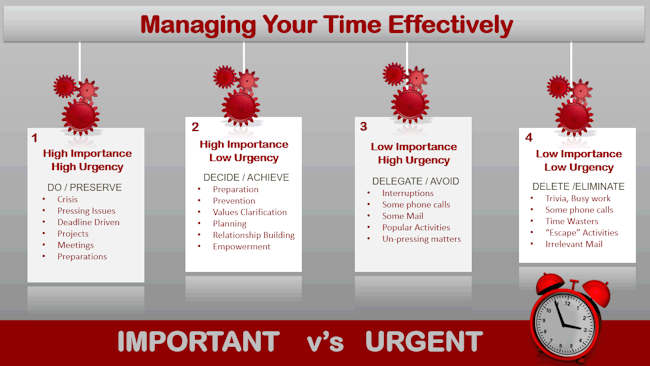
- Quadrant 1: High Importance – High Urgency
These are the most pressing tasks you should focus on immediately. These are the crises that will erupt if you don’t. The most urgent meetings or deadlines fall into this category. When we do fire-fighting, it’s all relating to stuff in this quadrant. - Quadrant 2: High Importance – Low Urgency
These are the things that matter in the long-term but will yield no tangible benefits immediately. They are things we know we need to get done and will have an impact on the business if they aren’t completed. It’s having a lunch with a significant contact or client, relationship-building and long-term planning. - Quadrant 3: Low Importance – High Urgency
These tasks are the biggest reason you are not more successful in the long-term! They clog up your time today, but when you look back at these things, you will have to admit they were a waste of time. These are interruptions that happen, such as unnecessary phone calls, poorly thought-out meetings that soak up hours of your time, activities which you believe in the moment that you must do, but if you stopped to really think about these tasks, you would realise they aren’t that important. - Quadrant 4: Low Importantance – Low Urgency
These are the things you do when you’re tired and need a break. It’s checking Facebook and Twitter during the day, because we think we might miss something. It might be mindlessly eating potato chips, even though we’re not hungry. You will be amazed how much time you spend in this quadrant wasting time and avoiding the most important task that will make a difference to your business.
To successfully use this method of planning, you must have a very clear understanding of what is important to you and what both your long-term personal and business goals are.
“Remember that people don’t plan to fail, they just fail to plan!”
If you’d like some help setting SMART goals and taking the steps you need to move your business toward them, do give me a call on 01280 700405 or click here to ping me an email and let’s see how I can help you.
Until next time …

KATH BONNER-DUNHAM
There is no mystery to it …
Networking is simply about connecting with people, yet walking into a room where you don’t know anyone can rank up there with the other great fears such as public speaking when it comes to ‘out of the comfort zone’ experiences …
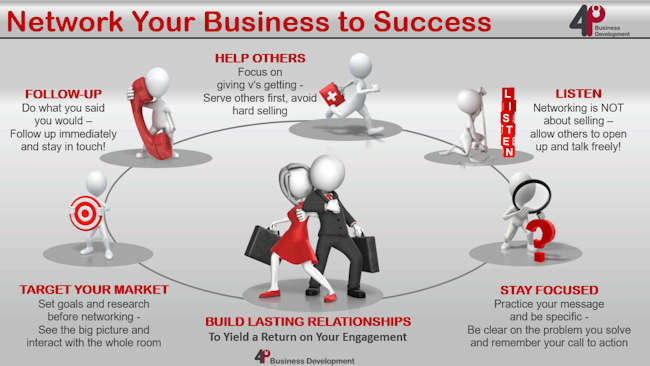
Networking is a great way to grow your business, but it can be scary at first!
copyright: 4p business development
A lot of people are afraid of networking groups, but the truth is, we are all natural networkers; we do it every day with our family, friends and colleagues.
As we chat, add value and connect, we hope to uncover opportunities and increase our knowledge of other businesses so we can plug them into other contacts we may have and generate potential sales leads for our own business.
Even in today’s technology driven marketing environment, over 80% of new business is gained through formal or informal networks online and offline through the oldest marketing tool, word of mouth.
So choosing not to include networking as an integral part of your marketing strategy cuts you off from a vital and vibrant source of new business.
Networking is defined as “developing an extended group of people with similar interests or concerns who can interact and remain in contact for mutual assistance or support”. Something to note is that it’s important to develop these contacts well before you need them.
“Think of networking as a long-term proposition!”
It’s about cultivating positive relationships which are built on giving rather than taking. As well as identifying new business opportunities, networking allows you to share ideas, experience and good practice. You can meet inspirational role models, overcome isolation by meeting new people as being in business for yourself can be lonely at times, or maybe find new suppliers as well as developing relationships already started.
It is easy to become isolated and lose touch with what is happening around you, especially in the early days of building a business. For me, the key to successful networking is being ready to serve first, give rather than take, follow up professionally and always be willing to help others by introducing people and initiating relationships.
When it’s such a low cost, high reward activity, it amazes me how many business owners find themselves committing one of the 7 Networking Sins without even realising it.
So what are the 7 Sins of Networking? Let’s explore them more:
-
Poor preparation and planning
Failure to set goals and research before the meeting.
-
Failure to act professionally
Lack of business cards, or being dressed inappropriately for your brand using poor body language.
-
Failure to work the room
Hiding in the shadows, avoiding eye contact and only talking to people you already know.
-
Poverty mindset
Failure in seeing the bigger picture, only seeing the people in the room and not understanding that everyone has a wider network behind them and remembering to celebrate the wins of others in the room.
-
Focused on getting vs giving
Selling hard without permission, not serving others first.
-
Unable to deliver a clear message
Failure in being specific and clear on the pain that you solve for people, forgetting your target market and no offer or call to action.
-
Lack of follow-up
Failure to help generate business through referrals for others, lack of ‘permission’ database to stay in touch and no processes for keeping the conversation going.
Relationships matter. Most people have access to at least 250 contacts and your reputation needs to speak for itself. By going into networking with a ‘giving’ mindset, you’re creating an opportunity for people to really get to know you.
“You need to approach every networking situation with a genuine interest in people and a desire to help them!”
That’s how you leave a positive and lasting impression, and that’s why people will want to help you in return. That’s what networking (and life) is all about after all!
Now, don’t get stuck in a networking rut. Keep looking out for new and varied events to go to; clubs, associations, meetings, seminars, conferences, presentations, breakfast briefings, lunches, exhibitions.
Your aim is to increase your visibility, so present yourself as your brand and show people a consistent avatar. What I mean by that is that your online presence (website – Facebook – Twitter page etc) needs to match your offline presence (your business cards and yourself in person).
For example, I use the same photo on my Facebook profile, LinkedIn page and on my business cards, and I regularly get people recognising me who I have never met, but who already feel a connection with me.
So how would you do that? Here are my 5 steps to creating your perfect pitch:
-
Always be positive – sounds like common sense, but you would be amazed how many people I meet when networking who look like they got dragged there! By having an open ‘can do’ attitude and having the belief in giving and sharing, as well as offering assistance, your reputation will soon grow, and people will be attracted to your energy and personality.
-
Develop the ability to ‘Schmooze’ – being able to talk to anyone is a valuable skill in its own right and essential in business. Being able to initiate a conversation means you are more likely come into contact with people who may turn out to be valuable connections. Have a few phrases such as, “How did you get started in … ?”, “What do you particularly need to help you succeed?” and, “How would I recognise your ideal customer if I met them?” up your sleeve.
-
Develop your listening skills – networking is not about selling, it is about listening to the other person, allowing others to open up and talk freely. Take an interest in what’s said and encourage them by using positive body language and subtle mirroring techniques to develop rapport.
-
Remember your business cards – only 25% of business people have a card that is up to date and gives the receiver precious information about them. Ensure it has all your contact information, including all your social media addresses. Connection is the goal after all. Plus use both sides!
-
It’s vital to be organised – keep a database of everyone you know and meet, using memory joggers and any mutual contacts for future reference. Invest in your own Contact Relationship Management (CRM) software to make this easier.
At most structured events you will get to present to the room with (up to) a one-minute presentation and you need to make the most of this opportunity.
After all, how often do you get the chance to spotlight your business to a whole room of interested people? It’s a true high-impact marketing strategy, so make sure you include all of the following 7 key stages of your perfect pitch:
-
Your business name – you would be amazed how many people forget this simple step, speak at a reasonable pace and clearly so everyone can understand
-
The problems you solve – Talk about the type of problems you solve for your clients, this will resonate much more with the room and enables the member to see those problems in their own businesses
-
How you can help them – explain a bit more about how you work and tell them about the results you get for clients
-
What’s unique about you – how your past or perhaps a hobby gives you a unique perspective on what you do, your qualifications etc
-
What you are looking for – Explain your target market, your ideal client and also talk about collaborators and suppliers you may be seeking to work alongside
-
Your call to action – what you want your audience to do next, maybe offer a complimentary meeting or schedule a 1:1
-
Your contact details – repeat your name and the best and easiest way to make contact with you
And finally for today, lets finish by making sure you always set your intentions. You can do this in a number of ways. Set your intention to go Networking right now, put dates in your diary and commit to go.
When you arrive at all those meetings, know your minimum success outcome, what you have to come away with to make that investment of your time worthwhile.
“And remember, the size of your network will determine the value of your networth so happy networking!”
If you’d like to know more about networking or are considering working with a coach to move your business and your life to the next level then call me on
01280 700405 or click here to send me an email enquiry and let’s talk.
Until next time …

KATH BONNER-DUNHAM
|
PS: |
If you’re looking for a partner to help grow your business, visit www.4pbusinessdevelopment.co.uk to discover how 4P Business Development can help you! |
Do you know your niche?
Positioning is one of the most powerful marketing concepts. Primarily, it is about the place your brand occupies in the mind of your target audience and has become a regular marketing activity and strategy …
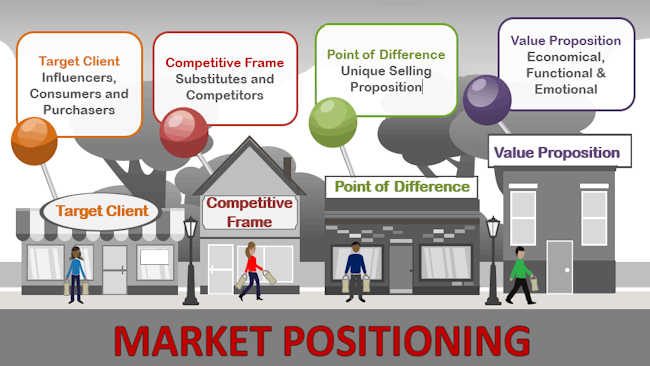
Positioning is to do with the place your brand occupies in the mind of your customers!
copyright: 4p business development
When did your last review your Positioning, marketing activity, PR, customer experience and client retention? Positioning is how you differentiate your product or service from that of your competitors and determine which market niche to fill.
“It helps establish your product’s or service’s identity within the eyes of your customers and clients!”
Do you believe in your product? And are you consistent and regular in the way you promote it? Well, unless you are, the odds of succeeding are substantially reduced.
Positioning specifically refers to the place that a brand occupies in the mind of your clients and how it is distinguished from the products or services from your competitors.
In order to position your products, it is essential for you to emphasise the distinguishing features of your brand. Get it right first time as once a brand has achieved a strong position in the market, it can become difficult to reposition it.
The four key areas to consider are:
-
Target Client
-
Influencers
-
Consumers
-
Purchasers
-
-
Competitive Frame
-
Substitutes
-
Competitors
-
-
Point of Difference
-
USP – Unique Selling Proposition
-
-
Value proposition
-
Economical
-
Functional
-
Emotional
-
Remember, you should not be thinking “I need a great logo” or “I need a new website and will base all my marketing collateral around that”. That’s what’s called ‘away from’ thinking.
No, what I help you to do is change your mindset to ‘towards’ so you think this way instead: “I want more customers” or “I want to increase my profit margin” or even “I want everyone to recognise my company name”.
I’ll ask you those bloody difficult questions which will enable you to make the best decisions about your target clients, the niche you want to position your products and services in, what your USP is and then work out your brand and the ‘things’ that are part of it.
“Would you like to know more?”
If you feel you’d like to talk to me about coaching and mentoring for you and your business and assistance with proper positioning, give me a call on 01280 700405 or click here to ping over an email enquiryand let’s talk.
Until next time …
KATH BONNER-DUNHAM
|
PS: |
If you’re looking for a partner to help grow your business, visit www.4pbusinessdevelopment.co.uk to discover how 4P Business Development can help you! |
And get to the important, urgent stuff …
It’s a proven fact that when you try to do everything at once in your business, nothing gets done. Unless you delegate, you’ll find yourself overwhelmed with trivial or non-urgent tasks …
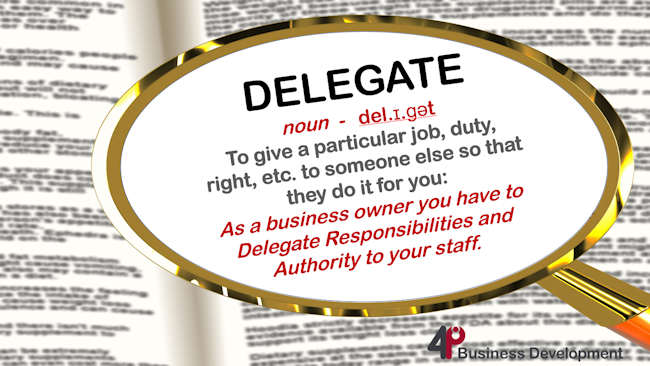
Learn to delegate more effectively, strategically and intentionally!
So where does that leave the important, urgent stuff? Somewhere in your todo list and probably not near the top either. It’s a very common scenario for many business owners.
The best way to delegate is to pick good people to do what needs to be done, empower them and give them the authority, responsibility and accountability for the job.
“Then STOP meddling and leave them to it!”
Being in business means taking every opportunity to grow. But it needs to be done effectively, strategically and, most importantly, intentionally.
Here are my top 6 ways to delegate more effectively:
-
Decide what tasks you’re going to delegate. Don’t chop and change from one moment to the other. Delegate and stick with your decision.
-
Don’t look for perfection. When the buck has always stopped with you, it is difficult to let go of certain tasks, but delegating them gives the other person the challenge to improve what they do.
-
Provide complete job instructions. Don’t set someone up to fail by not explaining exactly what you want them to do for you. The more information you give them, the better the result.
-
Stop believing you’re the only one who can do the job properly.No, you’re not! Give someone with the right skills and experience the task and let them get on with it.
-
Check on progress. It’s fine to check in with someone to see the progress of the task you delegated to them, but don’t micromanage them. Just let them get on with it and they’ll ask for help if they need it.
-
Say thank you. Everyone likes to be thanked for their efforts. If you thank someone for completing the task you delegated to them, then next time they do it, you’ll get the same, if not an improved, level of effort.
Remember that when you delegate a task to someone, you have to delegate the authority for them to be able to complete it. If they need specific information from other people and can’t get it, well, they’re going to have to come back to you. This is called ‘reverse delegation’ where the task can’t be completed without input from you.
Remember that delegation has many benefits, both for you and for your business. It offers team development, motivation, growth and learning opportunities. The only thing you as the business owner need to get past is letting go and actually learning to delegate.
“Would you like to know more?”
If you’d like to learn how to delegate or would like me to review which of your daily tasks could be done more effectively by others, do call me on 01280 700405 or click here to ping over an email and let’s see how I can help you.
Until next time …
KATH BONNER-DUNHAM
|
PS: |
If you’re looking for a partner to help grow your business, visit www.4pbusinessdevelopment.co.uk to discover how 4P Business Development can help you! |
The difference is in the risk …
What is the most successful way to find a new client? Over the years, I have tried every route known to man. Some are ok, some are a complete failure, some are amazing …

Introductions, Referrals and Recommendations are one way to find new clients!
copyright: 4p business development
In my experience, what works best for me and majority of my clients is referrals and recommendations. But a recommendation is not a guaranteed sale. It is an opportunity for somebody to present their business where that presentation will be looked forward to with anticipation.
Is there a difference between an introduction, a referral or a recommendation? Absolutely there is:
-
An introduction is when two parties are brought together by a third party for a potential mutual benefit.
-
A referral is primarily referring someone you know to one or more providers of the service they are seeking and enabling them to make their own choice.
-
A recommendation is much more. It is where you recommend someone to one of your trusted partners, where you can be sure that they are sincere and are in the position to offer the exact service require to solve a need.
If you can imagine the transfer of trust required to make a recommendation versus the limited trust expended to make an introduction, you can begin to see the difference.
Introductions can be made between parties you know well, or those who you barely know, with limited effect on your reputation. However, careful consideration needs to be given to recommendations in order to keep your valued reputation.
Would you give a recommendation for someone you barely know? Let ‘the cause’ become the ‘because’ – the reason – for people to do business with, and to refer business to, you.
It is absolutely necessary to know and trust your partners, to have proof of their competencies, quality of work and preferably have the first-hand experience of their work ethics before you ever consider making a referral or recommendation.
“Your reputation is at stake here!”
So just how do you go about getting quality referrals and recommendations? Well, you have to prove yourself to others then ask them.
Business colleagues may well believe that you are too busy to take on additional clients, so it is important when out networking, or building your trusted partners network that you also communicate exactly what you are looking for and what capacity you have to accommodate the extra business.
Referrals are the privilege of the opportunity given to you by someone else to potentially do business with someone who wants, needs or desires the products or services you offer.
“It is imperative that you understand as much as possible about both parties before any introductions are made!”
With this in mind, I would always suggest that you have a number of one-to-one, face-to-face meetings to get to know as much as you can about the other person before you consider recommending them to others.
Reputations take years to build but seconds to destroy. Make a bad referral, and you’ll put paid to all the hard work and effort you’ve put in to create your own trusted network.
“Would you like to know more?”
Referrals and recommendations to grow your business are just one element in the 4Ps of business. If you’d like to learn more, then do give me a call on 01280 700405 or click here to ping me an email and let’s see how I can help you.
Until next time …
KATH BONNER-DUNHAM
|
PS: |
If you’re looking for a partner to help grow your business, visit www.4pbusinessdevelopment.co.uk to discover how 4P Business Development can help you! |
For great City & Guilds courses …
Positioning is our ‘P’ for all things marketing, whether that’s PR, social media, advertising, blog writing, websites, literature or any other media channel and/or printed matter to get your products and services to market …

If you have an enthusiastic member of your team, then one of these City & Guilds courses from Mary Thomas at Concise Training could help both you and them!
copyright: mary thomas, concise training
One of the most frustrating aspects of assisting my clients in this area is the stuff around digital marketing. Clients are quite happy to outsource web design, blog writing and a number of other aspects of their marketing.
“But when it comes to digital marketing, they do not find it quite so easy!”
They want to do it in-house, for it to be their own voice, to be relevant and then find that they do not have an employee who has the skills or, more importantly, the passion to see it through.
Whilst delivering a marketing strategy workshop to a client this week it struck me that many of my clients are missing an opportunity. So, with that in mind, I made contact with one of my trusted partners to find out her views.
Mary Thomas is an expert in delivering successful digital media strategies and products for her clients, however, she is also an expert in training, was instrumental in creating the City & Guilds social media and digital marketing qualifications.
“Over to you Mary!”
Do you have a keen member of staff in your office who is passionate about the business, who has a vision as to how to market and promote the business digitally and most importantly wants to improve their own skills and knowledge?
If so, perhaps a City & Guild qualification studied over a 12 – 18 month period will be just the opportunity for growth they are seeking? More importantly, this will then give your business a structured, professional approach to digital marketing.
I worked with City & Guilds to develop three practical qualifications to give your employees the skills they need to do their job more effectively for you and to develop their own career.
-
City and Guilds Social Media Certificate – ITQ
Learn to use a range of social media channels in a structured way. You will learn using 12 of our high quality, interactive e-learning courses. You will be asked to complete 11 assignments to show evidence of the practical use of the channels. Individual feedback is given on each assignment to enhance your learning.
Once all tasks are complete, you will achieve the City & Guilds ITQ Social Media Certificate. This is a highly practical qualification aimed at individuals who are new to the use of social media. It is suitable for individuals using social media for business as well as those using it for their own professional brand. Full support is included.
-
City and Guilds Diploma in Social Media for Business
-
Take your use of social media to the next level, with our City & Guilds Diploma in Social Media for Business. This qualification is aimed at those who use a range of social media channels, but want to learn about the application of social media in a marketing environment. The delivery is via 13 x webinars and 14 x e-learning courses over 12 months with start dates in January, March, May and September.
Assessed via a portfolio of evidence with tasks designed to capture practical skills and understanding of social media within a business. Individual, personalised feedback is given in each assignment. Full support is included.
-
City and Guilds Diploma in Digital Marketing
These days, it is important to understand digital marketing as a whole. This course covers the full spectrum of digital marketing from social media, websites, e-mail newsletters and content marketing within a marketing environment.
The course provides comprehensive cover of digital marketing techniques including creating a digital marketing strategy (with customer audit) and marketing plan, designing and creating an optimised WordPress website, using e-mail newsletters and creating a range of digital content including videos, e-books, infographics, images, blogs, status updates as well as digital advertising and lead generation. The course is taught over 15 months, using 19 webinars and 17 e-learning courses with start dates in February, June and October.
It is assessed using a portfolio of evidence designed to capture the practical creation of content, websites, etc. as well as establishing a sound knowledge base. Individual, personalised feedback is given on each assignment to ensure full understanding and practical use in a business environment. Full support is included.
|
|
To find out more about Concise Training and their training programmes you can visit their website or contact me and I’ll pass on your details to Mary.
“Would you like to know more?”
If you’d like to find out more about how I can assist in your marketing strategy or if you are interested in one of my marketing strategy workshops for your business, do give me a call on 01280 700405 or click here to ping me an email and let’s see how I can help you.
Until next time …
KATH BONNER-DUNHAM
|
PS: |
If you’re looking for a partner to help grow your business, visit www.4pbusinessdevelopment.co.uk to discover how 4P Business Development can help you! |
How to provide dividend income for spouses …
Working with business owners as a business coach means that I get involved in all aspects of the business, albeit that the core areas that I approach are planning, people, processes and positioning …

Transferring shares to your spouse can have tax benefits, but it needs to be done right!
copyright: lightwise / 123rf stock photo (licensee)
It never ceases to surprise me how little attention is given to the financial considerations within the business and perhaps more importantly, if that is a family owned business, how much importance is given to the family finances.
So many business owners fail to keep a track on their profit and loss and rarely focus on a forecast. It is so easy today with all the latest software and with digital taxation just around the corner.
Then there is the consideration of the family finances for the owner’s future. How best to invest for retirement, what tax saving can be made and how to deal with any existing or potential taxation issues.
Ordinarily, you may think that these are the sort of questions you should discuss with your accountant, however, the whole issue of personal, business and property taxation is a minefield and, in my view, you should always consult a tax consultant who is an expert in the field.
Working with my trusted partners I would always recommend that you at the very least have a conversation with Helen Beaumont of Essendon Tax Consultancy. Helen is a highly experienced, qualified chartered tax advisor
Here is an exert from her blog where she talks about ‘How to provide dividend income for spouses, ensure the shares are transferred or issued to them in a robust manner that avoids any challenge from HMRC’.
|
|
I am often asked by owner-managed companies, whether it makes sense to have some of the shares owned by their spouse. For tax purposes, the answer is mostly yes, but there are some non-tax reasons why it may not be a good idea.
Under previous rules (pre 6 April 2016), owner-managers were able to pay ‘tax-free’ dividends to their spouses (or civil partner) of around £35,000 (if we assume they had no other taxable income).
“Because if the spouse did not work in the company, it was not possible to justify any salary!”
However, since 2016/17, this has changed with the abolition of the 10% dividend tax credit and the introduction of a 7.5% (basic rate) charge on dividend income. However, this does not mean that spousal dividend planning is dead.
There is a potential for HMRC to challenge any dividends paid to your spouse and this was highlighted in the Arctic Systems case where HMRC argued that it was tax avoidance by passing dividends to the spouse when the owner-manager was obviously going to benefit.
Spousal dividend planning requires careful implementation so if you are thinking of transferring shares to your spouse and don’t want to be scrutinised by HMRC then it is worth talking to a tax advisor to ensure the transfer is done properly.
|
|
“Would you like to know more?”
If you’d like to find out more about Helen Beaumont and Essendon Tax, personal or business tax planning then do give me a call on 01280 700405 or click here to ping me an email and let’s see how I can help you.
Until next time …
KATH BONNER-DUNHAM
|
PS: |
If you’re looking for a partner to help grow your business, visit www.4pbusinessdevelopment.co.uk to discover how 4P Business Development can help you! |
An expert in a lot of online stuff …
Online marketing is not an area I’m overly familiar with. Yes, I use Facebook and can share stuff and comment, but when it comes to getting my brand out there, I’d rather delegate it to a trusted partner …
My trusted partner, Steffi Lewis is the business blogging expert!
copyright: steffi lewis online marketing & videography
Experts are there to assist you with all aspects of your business. Don’t want to do something? Can’t do something? Haven’t got the time to learn how? Working with an expert (in my case I call them my ‘trusted partners’) means you can delegate any aspect of your business that isn’t a core skill.
“Let me tell you about Steffi Lewis!”
I’ve followed Steffi for years and watched with admiration as she went through a major, life-threatening illness, but was able to keep her business going through all of it. Knowing she was back to full strength again, I wanted to meet this inspirational entrepreneur and following a number of conversations, we agreed to work together.
Steffi is the business blogging expert. Day in, day out, she creates finished, polished blog posts for her clients and has extra plug-in services that extend what she can do. The most amazing thing is that she developed the technology to do all this herself! There’s no WordPress or MailChimp here … it’s all pure Steffi Lewis, and it works.
Over to you Steffi …
|
|
The process of building a blog post for one of my clients is quite in depth. From the moment they submit their ‘raw thoughts’ to the instant it is published, what actually happens within my editorial system?
I define raw thoughts as four or five good paragraphs of text about a specific subject that you’re an expert in. It’s a data dump; you start typing and stop when you’re finished. Don’t worry about spelling or grammar or focus or flow as I sort all that out for you when I edit it. This is part of what I do:
-
Editing for spelling & grammar
I check the spelling and ensure the grammar is perfect. Remember that human beings will be reading this and there are many ways to make the words flow correctly, ensuring it is readable from start to finish.
I sometimes need to add the odd sentence or paragraph if the client hasn’t submitted enough, but they’ll always ensure it is in the spirit of the original raw thoughts and flows correctly within the overall text.
Occasionally we’ll need to delete text. This happens when the original raw thoughts have a ‘split focus’ and will go with the strongest of the two, building the blog post around that and removing the weaker one.
-
Editing for keyphrases
Blog posts are always about something specific so using my built-in analysis tools, I can get the system to suggest a range of keyphrases for Google.
I grab one with low competition, but high search rates and fit it into the text so that Google includes the blog post in search results for that specific phrase. This sometimes means a rewrite of part of the text to make the keyphrase fit.
-
Editing for NLP Linguistics
I believe it is very important to make a blog post interesting for the widest possible audience. Different people learn and understand in different ways so I sometimes modify the text to accommodate them.
Neuro-Linguistic Programming (NLP) tells us that there are four primary ‘internal representations’. These are Auditory Digital (thinking), Visual (seeing), Auditory Tonal (hearing) and Kinaesthetic (feeling).
I know the internal representation system of our clients (I just look at the raw thoughts and my analysis tools show me the verb usage), then I can modify these ‘predicates’ so there is more of a balance between all four of these major internal representation systems.
-
I/We/You usage
Blogs and web pages are very different. Most websites talk about a company so use ‘we’, ‘us’ and ‘our’ a lot. But blog posts fall into one of two categories – either an ‘inward’ post that uses ‘I’ or an ‘outward’ post that uses ‘you’.
My analysis tools give me the balance between I, we and you then I decide if it’s going to be a personal post (about the authors own experiences) or a helpful post (giving the reader a nugget of useful information they can use in their own life) and change the wording accordingly.
-
The perfect image
By the time I’ve edited the text and applied the previous four processes to it, I have a pretty good idea of the perfect image to go with it and what the caption should be (Google image search uses the caption so it makes sense to have one).
I have access to over 19 million images and usually find exactly what I’m looking for. A blog post must have an image to go with it and I’ll always find the perfect one. Oh, and I don’t charge extra to license these images … they’re included in the monthly subscription.
I’ve taken a long time to develop my analysis tools and I use them every day to produce the perfect blog posts for my clients. When you read any of my clients’ work then you’ll always find them engaging, informative and useful.
Yes, you can do this yourself each week by creating your own blog and spending hours writing then editing then finding the perfect image, but I do that for my clients – day in and day out – and have polished the process so well that it takes me less than an hour from the original “I’m editing your submission” email to the “your blog post is ready for your approval” email where I include the permalink for you to review.
Editing for spelling and grammar, editing for keyphrases, editing for NLP linguistics, checking the I/we/you usage, choosing the perfect image … it takes time to create the perfect blog post.
|
|
Whilst coaching and mentoring the business owners I work with, we take a considerable amount of time considering their ‘positioning’ which is the 4P Business Development “P” for branding, marketing, promotion and advertising.
When you want to include a blog as part of your marketing strategy it is absolutely crucial that you get it right, which is why I’m pleased to feature Steffi Lewis here this week.
“Would you like to know more?”
If you’d like to find out more about business blogging and how Steffi can help you then do visit www.steffilewis.com or to talk about positioning your business and learning how to delegate, give me a call on 01280 700405 or click here to ping me an email and let’s see how I can help you.
Until next time …
KATH BONNER-DUNHAM
|
PS: |
If you’re looking for a partner to help grow your business, visit www.4pbusinessdevelopment.co.uk to discover how 4P Business Development can help you! |
An accountant who gives you the data you need …
Working with my clients, I’m frequently asked to assist with some aspect of finances ranging from assisting them in understanding the basics of business finance to actually attending their meetings with their accountant …

The roll-out of Making Tax Digital has already begun. Are you ready for it?
copyright: fgnopporn / 123rf stock photo (licensee)
The immediate values to a joint meeting are that I am able to ensure that the correct questions are asked and that the accountant is talking to them in a language and vocabulary that they understand.
“And I can ask those Bloody Difficult Questions that need to be asked!”
All too often, I hear business owners say that they are unable to get the information they need to make an informed decision from their accountant. There could be a number of reasons for this, but an immediate area to consider is whether the correct information is being recorded in a fashion to enable the data and KPIs to be extracted.
These are just a few examples of the questions I believe you should be able to get an answer to from your accountant:
Can you tell what are my most profitable products?
Who are my most profitable clients?
How can I save money on fixed costs?
What variable costs need to be addressed?
When should I invest in new equipment?
How can I take money out of the business in the most tax-efficient manner?
Should I be flat rate VAT registered?
Should I use cash accounting?
With all the changes to the processes available to every business these days, and the fact that within the next couple of years you will all be expected to keep all your accounting records electronically, there are considerations to be made as to which is the best accounting system for you.
One of my trusted partners is Roger Eddowes of Essendon Accounts and Tax Ltd. Below is an extract from one of his recent blogs on”Making Tax Digital”.
|
|
According to HM Revenue & Customs (HMRC) Making Tax Digital is an essential part of the Government’s plans to make it easier for individuals and businesses to get their tax right and keep on top of their affairs.
On 13 July 2017, the Government announced that Making Tax Digital (MTD) would be delayed for businesses until 2020 except for VAT. MTD then featured in the Finance Bill information published on 8 September, and further draft legislation and guidance was published on 13 September.
“Making Tax Digital means the end of the annual tax return for millions!”
The original plan from the Government and HMRC would have seen small businesses and sole traders start quarterly reporting from April 2017, but those with a turnover below the VAT threshold (currently £85,000) will now be exempt from quarterly reporting requirements unless they choose to do so.
April 2019 will be the starting date for unincorporated businesses with a turnover above the VAT threshold to start keeping digital records for VAT purposes only. Businesses will not be asked to make the switch to MTD and update HMRC quarterly for other taxes until at least 2020.
The roll-out of the initiative has already begun. Every small business owner and individual taxpayer now have access to a digital account that they can use to check their records and manage their details with HMRC.
“Have you accessed yours yet?”
Under MTD, HMRC aims to join up its internal systems and so create one account for each taxpayer, for all their different taxes. The aim will be that through your digital account you will be presented with a complete picture of your business’s tax affairs and you will be able to manage all of your liabilities at the same time, in one place.
Although HMRC claims that the annual tax return will go, businesses will still need to prepare year end accounts, renamed as the ‘year-end declaration’, in order to reconcile their quarterly payments and claim various reliefs and make accounting adjustments.
As part of the year-end declaration, it appears that HMRC will pre-populate some of the return figures such as bank interest, income from employment and pensions using the links with other internal systems. It is important to remember to check any pre-populated fields as HMRC will not always be correct.
|
|
If you’d like to find out more about Roger Eddowes and Essendon Accounts, Making Tax Digital, or working with me to improve your people, processes, positioning and profitability then do give me a call on 01280 700405 or click here to ping me an email and let’s see how I can help you.
Until next time …
KATH BONNER-DUNHAM
|
PS: |
If you’re looking for a partner to help grow your business, visit www.4pbusinessdevelopment.co.uk to discover how 4P Business Development can help you! |
Your Employees deserve honesty …
The performance appraisal is your chance to find out the different causes of worker inefficiency and, at the same time, reward those employees who perform as expected …
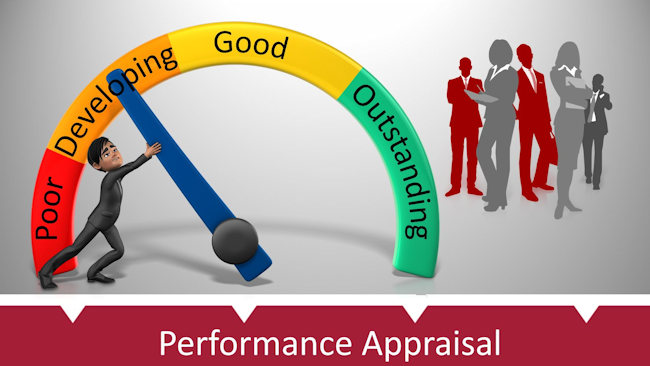
The performance appraisal is not a time to discuss rewards or to reprimand!
copyright: 4p business development
Despite its usefulness, the process is fraught with anxiety and difficulty, given the fact that some of the information that needs to be communicated to prospective employees may be negative, or may have adverse consequences, such as having to let go of a worker.
In order to get the best out of your employees and to be open and honest with them, you need to understand the necessity of being frank and open.
All too often, employers find themselves in a difficult situation, and maybe even a legal mess, due to giving an inaccurate appraisal during the performance review process.
“It is difficult, but you must be honest!”
For example, if the report on an employer’s appraisal states positively with regards to the skills and competencies of a worker who gets fired a few weeks later, this employee may seek legal advice or make a claim because their performance appraisal didn’t match the action taken later by the employer.
At the same time, misrepresenting information during the performance appraisal process is a bad idea, as being lenient towards one worker may be looked upon as normalised by others. This will most likely plant a seed of mistrust within your team.
Here are a few of the factors that you should take into consideration when carrying out a performance appraisal process:
Keep It Simple
A simple and straightforward approach is always preferred as it allows employees to answer questions easily and give you feedback based on documentable facts to use in your next approval.
Customize The Review Process
Performance appraisals cannot be the same for each employee as they all have different job descriptions and responsibilities. Ensure to base the evaluation on individual performance, which can be normalized across the board.
Consistency Is Key
It is very tempting to carry out performance appraisals in the face of a challenging situation in the workplace, such as a resignation or reorganisation that affects the entire team. Knee-jerk reactions do not go down well with employees who will be primed to defend themselves. People thrive on positive motivation and solid consistency from management, so only carry out performance appraisals when absolutely necessary.
Always Be Honest
Honesty also plays its part regarding being specific as to what behaviours you want to see an employee change. Being vague will not address any issues and drags down the rest of the team. Give your employee a deadline as to when you want to see the changes or improvement, which will help them focus their efforts on changing the issue at hand.
Lastly, honest feedback promotes respect between the team and management. The discomfort factor of a performance appraisal far outweighs the problems that might develop along the way if you skirt around the trust of an employee’s performance.
“The performance appraisal process holds the promise of growth and future benefits for everyone involved!”
Remember, a performance appraisal is definitely not a time for discussing rewards or a time to reprimand. The whole exercise should be about both the employer and the employee understanding:
-
Where we are now against targets, KPI’s and SOP’s, etc
-
Where the gaps are
-
What support and/or training the employee requires
-
How the employer can assist in getting the work up to standard
-
Agreeing the next steps
Ii may be necessary to arrange more regular performance appraisals in order to assist the employee and to monitor their progress.
Remember that the company’s policies should make it very clear that an appraisal can be called by either the employer or the employee before the scheduled date of the next appraisal.
“Like everything else you do in business, there should be policies and processes to appraise an employee’s progress!”
Should you require assistance with this or just like to find out more about a robust performance appraisal system, call me on 01280 700405 or click here to ping me an email and let’s see how I can help you.
Until next time …
KATH BONNER-DUNHAM
|
PS: |
If you’re looking for a partner to help grow your business, visit www.4pbusinessdevelopment.co.uk to discover how 4P Business Development can help you! |
Do you know who you can delegate to?
It is important to understand that when you delegate something to your team that you keep hold of some of the responsibility such as the support mechanisms. However, it is far more important that the team have the correct skills and competencies …

Having a team of trusted partners makes it easier to delegate tasks!
copyright: ellen willoughby, all about productivity
Quite often you will find that you do not have sufficient skills in-house to complete the job as an expert would, so why not delegate the work out to a third party who is an expert?
I have a bank of experts that I can call on to assist my clients from accountants and bookkeepers to gardeners, photographers and web designers. One expert that I would like to introduce you to today is Ellen Willoughby from All About Quality who is an expert in everything ISO9001.
“Here’s an extract from one of her latest blog posts!”
When your a small business, the thought of implementing a standard such as ISO9001 may seem a daunting task. However, that doesn’t mean that you can’t improve what you’re doing in a systematic way.
The ‘5s quality methodology’ is ideally suited to small businesses. The 5s’s will help get your business into top shape so that when the time comes from you to implement standards like ISO9001 you will already have the foundation for it embedded into your business.
The 5s’s are listed below. These apply equally well to those who work in services and use computers as their ‘workbench’ as it does for manufacturing and engineering companies.
-
SORT
-
Remove unnecessary items and dispose of them properly
-
Make work easier by eliminating obstacles
-
Reduce chance of being disturbed by unnecessary items
-
Prevent accumulation of unnecessary items
-
Remove all parts not in use
-
Segregate unwanted materials
-
Don’t keep or segregate unneeded items
-
-
STREAMLINE
-
Arrange all items so they are easily selected to use
-
Prevent waste and loss of time
-
Make it easy to pick up and find necessary items
-
Make workflow easier and smoother
-
Make things regular
-
-
SHINE
-
Sweep, sanitize and scrub
-
Clean workplace completely
-
Use cleaning as inspection
-
Prevent equipment deterioration
-
Keep workplace easy and safe to use
-
Keep your workplace pleasing to work in
-
-
STANDARDIZE
-
Standardise all best practices in the workplace
-
Maintain standards of housekeeping
-
Maintain everything in order and according to its standard
-
Everything in its right place
-
Every process has its standard
-
-
SUSTAIN
-
To keep in working order
-
To do without being told
-
Perform regular audits
-
Training and discipline
-
Get feedback regularly
-
I hope that the above list has given you some idea on how to improve your business. I did this as a presentation at a networking event once and a lot of people reported they went home and cleared there computers and desks of all old and irrelevant items so found immediate benefit from it.
All About Quality helps clients implement 5s in their businesses by working systematically through a checklist, helping them implement the steps and holding them accountable for changes made.
“Would you like to know more?”
If you would like to have a 5s improvement programme for your business no matter how small or large pleased do contact Ellen on 01604 210488 or click here to ping me an email and I’ll forward your enquiry.
Until next time …
KATH BONNER-DUNHAM
|
PS: |
If you’re looking for a partner to help grow your business, visit www.4pbusinessdevelopment.co.uk to discover how 4P Business Development can help you! |
Lead and they will follow …
Leaders are people who do the right thing; managers are people who do things right. So what are the characteristics of a good leader, what traits make a person a leader and not just another manager?

What makes for effective leadership? Or are you just another manager?
copyright: 4p business development
According to the idea of transformational leadership, an effective leader is a person who:
-
Creates an inspiring vision of the future
-
Motivates and inspires people to engage with that vision
-
Manages delivery of the vision
-
Coaches and builds a team, so that it is more effective at achieving the vision
Leadership can be hard to define, and it means different things to different people. In the transformational leadership model, leaders set direction and help themselves and others to do the right thing to move forward.
To do this, they create an inspiring vision, and then motivate and inspire others to reach that vision. They also manage the delivery of the vision, either directly or indirectly, and build and coach their teams to make them ever stronger.
“My question to you: what can you do differently to become a good leader? Someone others want to follow?”
There is so much written about how to be a successful leader, and it’s hard to know exactly where to start. Here are my top 10 tips on what you can do to be a better leader:
-
Think positively – provide a compelling vision for the future of your business in a manner that inspires the people you are leading. Set the tone for the appropriate behaviour you would expect of your team and where necessary introduce guidelines. Of course the better you are at demonstrating these traits the better your team will be.
-
Exhibit confidence – not to be confused with arrogance or self-gratification. Ideally you would like your team to look up to you for inspiration and guidance. Take on a calm and poised manner those around you are far more likely to act in this manner and the self-esteem of the team will be raised.
-
Be emotionally aware – have high ethical and moral standards. In all businesses you are dealing with people and this is more than likely the most costly part of your business and the most important asset you have. Wise leaders are very aware of emotions and strive to be sensitive of others. Learn more about emotional intelligence and how people interact and how you can improve this in your business.
-
Challenge your staff – to prevent complacency and boredom. People quickly become dissatisfied if they are continuously performing the same tasks and projects. It is important to provide goals and objectives that you can demonstrate your commitment to and how much you value their contribution. Rewarding their creativity and contribution will help to develop them to their full potential and increase productivity.
-
Manage failures – and provide a safe environment for trial and error. No matter how hard you try, mistakes and failure will always happen. The important thing is to understand this, be prepared and know how to deal with it. Always remain calm and think in a logical manner, consider the situation thoroughly and the resources available to you before taking any remedial action. Creating a calm environment in your business will assist your team in finding the best solution to any problems or setbacks they are faced with.
-
Listen – give feedback and practice effective communication. In leading a team it is extremely important that they are confident in openly discussing workplace issues with you, give them your time and keep confidentialities. Communicate clearly and honestly with the people around you, listening and interpreting properly what they have to say whilst ensuring that they fully understand your expectations. This will keep any misunderstandings to a minimum.
-
Encourage the people around you – encourage creativity and innovation, committing to others and their continuous training. Sometimes it is difficult to let other take the initiative, but if you can embrace and empower others to take their ideas to the next level, providing constructive advice and support, you can reap the benefits of deeper commitment enhanced problem-solving abilities and increased productivity.
-
Delegate – understand how and when to delegate and clearly communicate expectations. No matter how much you would like to, it is not actually possible for your to do everything yourself. Even if this were possible it would not be appropriate in a team environment. In order to delegate you will need to fully understand the skills and competencies of each team member and be mindful to ensure that they feel appreciated and trusted. It is important to recognise that delegation allows you to demonstrate your confidence in your teams and results in higher morale in the business.
-
Manage performance – any leader knows how important it is to develop the skills of those around them by setting clear and concise expectations in a formal manner. When everyone knows exactly what is expected of them, there is little room for uncertainty and any performance issues can be dealt with quickly. Managing the performance of your team and committing to continuous growth will result in increased productivity and profitability.
-
Find a business mentor – there is always more to learn and it is important that you create this opportunity for yourself. Find a trusted person with whom you are able to discuss all aspects of your business, someone who will question the status quo and assist you in making an informed decision to enable to grow a successful business.
Choose to lead and be the person others want to follow. Live your values and beliefs and set the pace through your own actions and expectations, and you will become an awesome leader.
“Would you like to know more?”
If anything I’ve said resonates with you and you’d like to find out more about leadership then do give me a call on 01280 700405 or click here to send me an email enquiry and let’s see how I can help you.
Until next time …
KATH BONNER-DUNHAM
|
PS: |
If you’re looking for a partner to help grow your business, visit www.4pbusinessdevelopment.co.uk to discover how 4P Business Development can help you! |
For successful delegation …
The authority, responsibility and accountability for the task changes hands when a manager, or superior employee, delegates a task down the hierarchy …
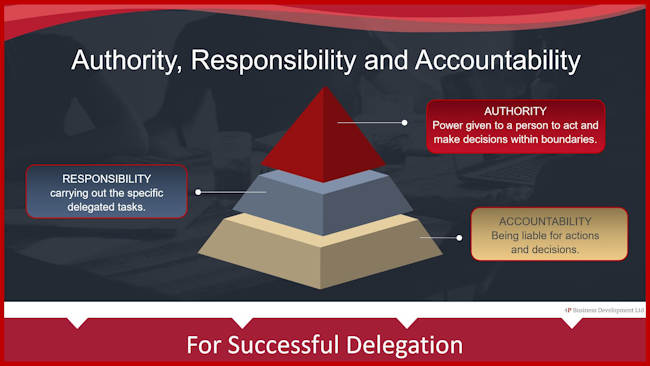
Authority, responsibility and accountability are 3 key terms in the process of delegation!
copyright: 4p business development
Prior to delegating any task, it is essential to understand how delegation is affected by your ability to manage your employees. You must have the ability to delegate the authority, responsibility and accountability.
“Always choose the most suitable employee with the skills and competencies to fulfil the requirements!”
There is often some confusion over the difference between these three terms that are essential for successful delegation. Here’s a brief explanation of each:
-
Authority always flow downwards. It is the power given to a manager or leader to act and make decisions within designated boundaries and achieve organisational objectives.
Ordinarily, the authority is shared between the manager and the person receiving the delegation. An organisation cannot exist successfully without authority.
It is expected that this individual will exercise the full scope of his authority to properly, profitably, and professionally manage the task. Without authority, a manager ceases to be a manager, it indicates the right and power of making decisions, giving orders and instructions to subordinates.
Stress comes from doing it all on your own so delegate … and give the authority to a trusted employee.
-
Responsibility refers to the act of carrying out the specific task, an obligation upon people deemed as responsible. When delegating a task, the manager and person receiving the delegation share the responsibility of completing the work.
The term ‘responsibility’ is often referred to as “an obligation to perform a particular task assigned to a subordinate. In an organisation, responsibility is the duty as per the guidelines issued”.
When delegating a task, both the manager and the person receiving the delegation share the responsibility of completing the work. The manager has the responsibility of providing instructions on what work needs to be done, while the person receiving the delegation is responsible for figuring out how the task should be completed.
Therefore, a leader is responsible and has responsibility for the operation for which they have been given authority. The essence of responsibility is the obligation of a subordinate to perform the duty assigned.
-
It always originates from the superior-subordinate relationship
-
Responsibility is in the form of a continuing obligation
-
The person accepting responsibility is accountable for the performance of assigned duties
Usually, authority flows downwards whereas accountability flow upwards.
-
-
Accountability always flows upwards; it is the act of being liable for actions and decisions. Accountability is the obligation of an individual to report formally to his superior about the work he has done to discharge the responsibility, and every employee should be held accountable for jobs assigned to them and be able to complete that job as per the standards set by the superior.
During delegation of a task, the accountability of the task transfers from the manager to the person receiving the delegation and actually completing the work. It is the answerability for the performance of the assigned duties and any positive or negative consequences associated with their performance are ultimately their responsibility.
When delegating, authority, responsibility and accountability are all interrelated. A manager is responsible for all actions of employees under his leadership even if there are a number of layers in the organisation.
Accountability means that the subordinate should explain any factors that are responsible for poor or lack of performance, however, the manager is ultimately responsible for the overall performance of the employee.
Authority, responsibility and accountability are 3 key terms in the process of delegation, and if you would like to know more then do give me a call on 01280 700405 or click here to ping me an email and let’s see how I can help you.
Until next time …
KATH BONNER-DUNHAM
|
PS: |
If you’re looking for a partner to help grow your business, visit www.4pbusinessdevelopment.co.uk to discover how 4P Business Development can help you! |
Do great things, make an impact; delegate …
Have you ever asked yourself the question: why do so many business owners and managers fail at successful delegation? Have you fallen into that trap yourself?
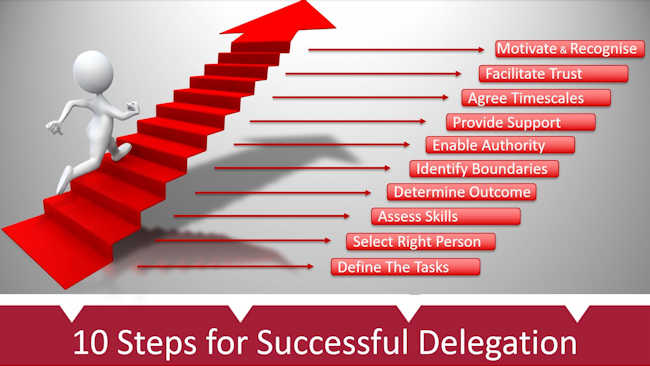
Learn successful delegation by following my top 10 steps!
copyright: 4p business development
All too often managers struggle to let go of client work or basic tasks and successfully delegate it to their staff.
While on the surface it may appear to be easier to do it yourself than to take the time to explain what you require together with the expected outcomes to someone else, there are two fundamental reasons why, in the longer term, it is better to delegate.
-
It is probable that your skills are better deployed developing the business strategy and leading the business. By carrying out the task yourself, you’re failing to make the best use of your time.
-
By involving other people in the tasks, you will be developing those people’s skills and abilities so that the next time a similar task is required, you will be able to delegate with a degree of confidence.
Are you limiting your success by failing to master the art of delegation? Are you taking care of the high-value work that only you can do such as:
-
Defining your business goals and positioning,
-
Networking and meeting with prospective referral partners and collaborators,
-
Negotiating the next highly profitable deal,
-
Public speaking on behalf of your business and raising the profile,
-
Defining your long-term business strategy.
Ideally, you should then be delegating all the other tasks, apart from a few carefully chosen activities that you find especially rewarding in other ways.
For successful delegation, you should be considering my top 10 steps, before, and during, every delegation process. You should then find that you delegate more effectively and successfully, providing you with more time to dedicate to working on the business.
Here they are:
Define the task, spelling out exactly what it is that needs to be done.
Select the correct person to carry out the job, someone with passion and is willing to take on such tasks.
Assess the skills and attributes of the chosen individual and ascertain if any training is required.
Clearly articulate the desired outcome; begin with the end in mind and specify the desired results.
Identify boundaries and be explicit as to the lines of authority, responsibility and accountability.
Be sure to match the level of responsibility with the level of authority. You will need to understand that you can delegate some responsibility, however, you can’t delegate the ultimate accountability.
Ensure that adequate support is provided at all times and be available to answer questions.
Agree and set the timescales and any constraints.
Facilitate trust and focus on results. It is important for you to remember that your way is not necessarily the only or even the best way. Allow the person to control his or her own methods and processes.
Build motivation and commitment. Enable the individual to identify future opportunities, and enable recognition where deserved.
Surround yourself with the best people you can find, delegate authority, and don’t interfere as long as the policies that you’ve decided upon are being carried out with the desired outcomes.
“Delegate, empower your team, increase productivity and get things done right!”
To learn more about successful delegation and how to empower your team, call me on 01280 700405 or click here to ping me an email and let’s see how I can help you.
Until next time …
KATH BONNER-DUNHAM
|
PS: |
If you’re looking for a partner to help grow your business, visit www.4pbusinessdevelopment.co.uk to discover how 4P Business Development can help you! |
And how you can fix it …
It’s quite common for people to confuse the difference between a marketing strategy and a marketing plan. All too often, businesses begin marketing without any clear strategy. Then they wonder why they are not achieving the results they expect …
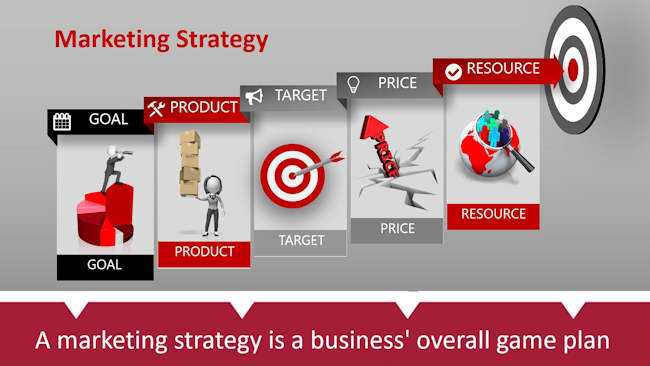
A marketing strategy is a business’ overall game plan!
copyright: 4p business development
-
Your marketing strategy consists of:
The “what” has to be done. Inform clients about the product or service being offered. Inform clients of differentiation factors.
-
Your marketing plan consists of:
The “how” to do it. Construct marketing campaigns and promotions that will achieve the “what” in your strategy.
Before you begin any marketing whatsoever, it is imperative that you consider all the steps in creating a robust marketing strategy. Furthermore, you must avoid the 7 top reasons your marketing strategy will fail:
-
Total lack of a robust marketing strategy
-
Marketing strategy misaligned with business strategy
-
Relying on tactics instead of strategies
-
Having the same strategy as your competition
-
Failure to meet the explicit needs of your target market
-
Failure of identifying the correct media channels to communicate effectively
-
Lack of budget and resources
Having a robust marketing strategy in place helps to ensure that your marketing activities remain aligned with your business goals. This maximizes the business return from your marketing efforts.
Here’s my 17 step marketing strategy framework that is guaranteed to deliver a robust marketing strategy for your business:
Business Definition – Outline the key definition of the business
Business Goals and Objectives – List all S.M.A.R.T. business goals and objectives
Strategic Marketing Goals and Objectives – List all S.M.A.R.T. marketing goals & objectives
Core Products – List all core products including those provided by a third party that add value
Competitors – Consider both direct and indirect
F.A.B – consider all Features Advantages & Benefits
Unique Selling Proposition – Identify what is totally unique about your offering
Profile of Target Market & Clients – Identify your target market, the perfect client that you would ideally like to attract, where are they and what do they look like
Models – Carry out an in-depth SWOT, TOWS and PESTLE analysis
Brand Message – Identify the key brand messages
Price – Nail down your price point, fixed costs vs variable, considering market trends etc
Media Channels – decide what channels are you going to use to reach your target market
Marketing Plan (Tactical) to achieve Marketing Strategy – Spreadsheet to identify every marketing activity by month with marketing message
Budget – ensure sufficient budget has been allocated to execute your strategy and achieve expected outcomes
Responsibilities and accountability – decide who does what and Identify the very best person to deliver each aspect of marketing plan
Resources – ensure that you have allocated sufficient resources to deliver your plan
Measure and review – put robust processes in place to enable to measure your R.O.I
For help in developing a marketing strategy, or for information on our Marketing Strategy Workshops, do call me on 01280 700405 or click here to ping over an email and let’s see how I can help.
Until next time …
KATH BONNER-DUNHAM
|
PS: |
If you’re looking for a partner to help grow your business, visit www.4pbusinessdevelopment.co.uk to discover how 4P Business Development can help you! |
If not, you could be losing business …
Are you using one of the numerous personal or free email addresses rather than getting yourself a branded company domain for your website and emails?
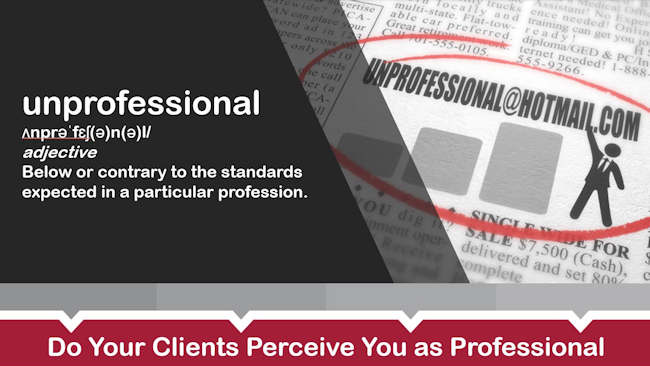
If your clients don’t perceive you as professional, you may be losing business!
copyright: 4p business development
Virtually every day, I see businesses promoting their products and services through adverts, websites and digital marketing and it amazes me just how many do not have a professional business email address.
Even more unbelievable is those that have gone to the trouble to purchase a domain name, build a website and still use a personal free email address!
What does this actually say about you and your business? Well, the word ‘unprofessional’ is defined as “below or contrary to the standards expected in a particular profession”.
Customers expect your business to have a domain name and a website. An email address like sales@domainname.co.uk tells your potential clients that you’re serious about your business. One called unprofessional@hotmail.com does not.
Furthermore, when you own your domain name, you are no longer tied to an email service provider or an ISP. Should you use a free address for your business, you are bound to them and cannot change email service providers or use additional services, such as encryption, that the free services do not offer.
A professional branded email address with a .co.uk or .com domain name can help build credibility and branding. Get a professional domain name the same as your company name and then you will:
-
Raise visibility and perception of your professionalism
-
Extend your branding
-
Create simplicity, enabling clients to remember your details
-
Enable scalability and allow more than one address within the domain
-
Take ownership and enables transfer between providers
-
Enable full control over all emails
Domain names and email addresses are not something any business owner should compromise on. Create a great first impression and make your contact details memorable and appropriate, not embarrassing and unprofessional.
“Would you like to know more?”
If you’d like to get a domain name registered and have your email setup (and maybe a nice website designed to boot), I can recommend people from my trusted partner list. You can call me on
01280 700405 or click here to ping over an email and let’s see how I can help.
Until next time …
KATH BONNER-DUNHAM
|
PS: |
If you’re looking for a partner to help grow your business, visit www.4pbusinessdevelopment.co.uk to discover how 4P Business Development can help you! |
Is your business a labour of love?
I frequently find that business owners, while they started the business because of their core skills and passion, discover they end up working longer hours than ever before and often for less financial reward …

If you’re thinking about taking time out from your business, read my 10 top tips!
copyright: 4p business development
According to Gallup Small Business Index survey:
-
57% of small-business owners say they work six or more days each week. In sharp contrast, only 7% say they work fewer than five days each week.
-
62% of small-business owners say they work 50 or more hours each week.
-
As if that’s not bad enough, A high percentage of small-business owners work while on their holidays, with 81% saying they made or returned business calls, and 52% initiating or answering e-mail.
So are you satisfied with your ability to achieve a positive work-life balance? With all the pressures of business and the responsibilities that go with it, how important is it for you to take time out?
Research has shown that 1.3million small business owners were suffering health issues due to the pressures of running a small business, with 660,000 of those feeling that it had a very adverse effect on their health.
How much better would your business be if you actually worked fewer hours, took time out and worked ON the business, rather than IN it? Almost everything will work again if you unplug it for a few moments, including You!
Here’s my top 10 tips to take time out and recharge your batteries:
Ensure you get sufficient sleep to restore your energy
Exercise and stay active as sitting all day is not good for us
Take time off; the time away will recharge your energy and focus
Make time to spend with family and friends, have fun and switch off
Take care of your health, eat regular healthy well-balanced meals
Indulge yourself in your hobbies or other planned activities
Ensure your workplace is pleasant and comfortable with plenty of light
Set communication boundaries limiting emails and social media
Set a clearly defined time for your working day to end
Think positively and remain optimistic as positive thoughts create positive results
Finally, remember to allocate specific times to work ON your business.
Should you chose to continue to work all the time in your business without giving yourself time out for relaxation, contemplation and growth, you will find it extremely difficult to progress and grow your business to achieve your core goals.
Create the opportunity to take time away from the business to increase your skills and to enable you to create strategic plans to take your business forward to the next level. Use your diary and schedule at least one day a month out of your business to focus on the future.
“Would you like to know more?”
Nor sure where to start when taking time out from your business, finding it difficult to set those big goals, don’t know what you don’t know or simply needing someone to question the status quo? Call me on 01280 700405 or click here to ping me an email and let’s see how I can help you.
Until next time …
KATH BONNER-DUNHAM
|
PS: |
If you’re looking for a partner to help grow your business, visit www.4pbusinessdevelopment.co.uk to discover how 4P Business Development can help you! |
The perils of running a family-owned business …
About half of all new businesses survive five years or more and about one-third survive 10 years or more. If you’re married to your work partner, then there’s a good chance that you can succeed …

When you are married to your work partner it’s not all black and white!
copyright: 4p business development
Today, there are more and more married couples in business together than ever before. Being married to your work partner, whilst still, a family business brings its own complications and areas that need to be managed carefully.
“One client often refers to me as their business coach AND a marriage guidance councellor!
I am really not sure about the last bit but do understand how during our regular meetings both areas tend to cross over. It probably can’t be helped when you’re married to your work partner.
Good planning is crucial to ensure all business goals are concurrent with life goals, and timelines are synchronised to run a successful profitable and sustainable business.
The Federation of Small Businesses have identified:
There was a record 5.7 million private sector businesses at the start of 2017.
Small businesses accounted for 99.3% of all private sector businesses; at the start of 2017 and 99.9% were small or medium-sized (SMEs).
Total employment in SMEs was 16.1 million; 60% of all private sector employment in the UK.
The majority of population growth since 2000 has been due to non-employing businesses, which accounted for 89% of the overall increase.
Non-employing businesses accounted for 79% of the overall 197,000 increase in the last year.
It’s not uncommon to see couples decide to go into business together. The close relationship, shared goals, and unwavering support they have together often make entrepreneurship seem like a natural fit.
“However, the closeness of living and working together, and the lack of personal space and time bring many challenges!”
According to Forbes, here’s How To Tackle The Biggest Entrepreneurial Challenges when working with family and/or partners, and how to overcome those challenges for a successful personal and professional partnership.
-
Discuss and establish operating norms
Explore each other’s values, assumptions, strengths and needs. Document and agree to some clear guidelines that define how you will honour the other person’s needs, and clear up assumptions.
Clarify how you will make decisions, and talk about guiding principles for your business and how that relates to the future you see for both your business and your relationship.
-
Get your legal issues and business contracts in place
It’s important to make sure that all legal and contractual measures are in place before any business partnership takes place, even in a marriage or intimate relationship. It allows the business to have a solid foundation independent of your personal relationship.
No matter what part of the relationship may turn sour, your business interests are protected, and a plan is in place to move forward.
-
Clearly define your roles and responsibilities
The biggest challenge I’ve seen is the clear line between who is ultimately the boss. Someone needs to make the final call, and that needs to be determined in advance for different situations, otherwise, roadblocks become impassable.
I find that clearly defining roles and responsibilities in the partnership, and respecting those, can be a huge step to having success.
-
Set aside time for non-work activities
Couplepreneurs often spend far more time together than average couples. To avoid relationship burnout, try not working in the same space. If that’s not possible, make sure your roles are clearly defined and separate so, your roles don’t collide, and you complement one another.
Remember to make a designated date night on a regular basis where you don’t discuss work and enjoy a shared hobby or nice meal out.
-
Plan for time away from work and each other
Successful couplepreneurs separate their work and home life. They define clear boundaries around their personal time. They disconnect from business issues and business talk at the end of the workday. They invest in their relationship by planning fun activities. They also have lives apart from each other, spending time with their individual friends.
I have a vast amount of experience working with family-owned businesses and businesses in which the work partners are also life partners. I am versed in dealing with the unique challenges these businesses face.
“Would you like to know more?”
If you’re married to your work partner and would like to know more about how I can coach your family-owned business, call me on
01280 700405 or click here to ping me an email and let’s see how I can help you.
Until next time …
KATH BONNER-DUNHAM
|
PS: |
If you’re looking for a partner to help grow your business, visit www.4pbusinessdevelopment.co.uk to discover how 4P Business Development can help you! |
Remember, people now have to opt-in …
The General Data Protection Regulations (GDPR) come into force in May this year. If you hold data on EU individuals then you have to get their consent to continue to receive your communications …
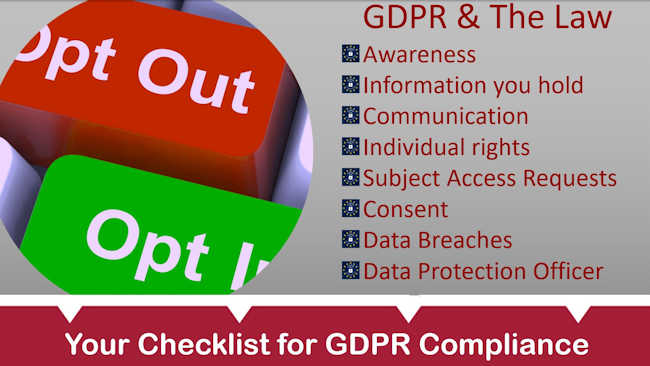
GDPR is going to have a major effect! Will you be caught out?
copyright: 4p business development
Previously, contact forms could have ticked opt-in fields and data could be held for as long as you liked (such as unsubscribed email addresses so you didn’t add them again). Thanks to GDPR, everything has changed.
GDPR will apply in the UK from May 2018 and replaces the Data Protection Act 1998 (DPA), however:
Did you know that the fines could be as much as £10m or 4% of your annual turnover (whichever is the greatest) per incident?
Do you believe that because you are a small business that these laws will not apply to you?
Will you continue to send out your communication, newsletters and other marketing material without taking the necessary steps?
Obtaining an ‘opt-in’ from the individuals in your database is just one step to protecting yourself.
Should you make the decision to continue sending out emails, mailshots and other communication in the same manner as you have always done, without gaining the individuals specific consent, you may find yourselves receiving a ‘Subject Access Request’ (SAR).
An SAR is a legal inquiry about why you have an individuals information, what you know about them and why you have it. You have to reply in a timely manner and you can’t charge for doing it.
Time is running out! Here are the top 6 things you should be considering immediately:
Put processes in place to ensure that you can demonstrate that the individual consented specifically to your communication (collect signatures through specific Opt-In process)
Where there are multiple matters, ensure that each individual consents specifically for different types of contact
Make it extremely easy for individuals to withdraw their consent
Ensure that all consent is freely given
Ensure that consent is no longer assumed by the provision of a service
That the individual absolutely understands what they are consenting to
For additional guidance, the Information Commissioners Office has published various guidelines and checklists to help you to understand and assess your level of compliance with data protection legislation.
They have created a PDF called ‘GDPR: 12 steps to take now’ which you can download by clicking here and further information for data controllers and data processors can be found here.
After considering all the information I have gleaned over the past few months from numerous seminars and events, I sent out an ‘opt-in’ email request to my database of existing and potential clients that I hold.
To date, I have received a positive response from less than 10% of my list. I will carry out this exercise once or maybe twice more after which time all data of those individuals who have not responded positively, will be removed from my newsletter database.
“How is this going to affect your business and how can you continue to attract new potential clients?”
If you’d like to get more insights about GDPR from my own experiences so far, do call me on 01280 700405 or click here to ping me an email and let’s see how I can help you.
Until next time …
KATH BONNER-DUNHAM
|
PS: |
If you’re looking for a partner to help grow your business, visit www.4pbusinessdevelopment.co.uk to discover how 4P Business Development can help you! |
Say what you mean and mean what you say …
I notice many different styles of communication when working with clients and today explain some of those styles and how you can communicate more effectively by adapting your style to becoming more assertive …
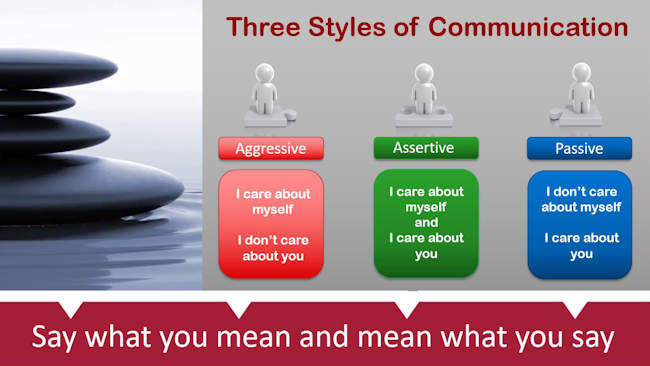
You can communicate more effectively by being assertive, but not aggressive!
copyright: 4p business development
A good understanding of the three primary styles of communication will help you learn how to react most effectively when confronted with a difficult person.
Perhaps, more importantly, it will assist you in recognising when you are not being assertive or not behaving in the most effective way!
Remember, whilst you always have a choice as to which communication style you use, being assertive is usually the most effective, but other styles are necessary for certain situations.
Learning to identify the different communication styles and recognising which one you ordinarily use in your daily interactions with colleagues and employees is essential when you need to develop effective, assertive communication skills.
The three main different styles in yourself and others:
-
Being assertive is where you have respect for both yourself and other people. It is seen as the ability to clearly express your thoughts and feelings through open, honest and direct communication; to be clear, direct, and respectful in how you communicate.
-
Being passive is where you care more about other people and are not an advocate for yourself and your own feelings.
-
Being aggressive is where you care more about yourself and attempt to run roughshod over others with little care for their feelings
If you’re serious about strengthening your relationships, reducing stress from conflict and decreasing unnecessary anxiety in your business, you must practice being more assertive.
“This will help you diffuse anger, reduce guilt and build better relationships both personally and professionally!”
As a business owner, you must be confident in who you are, what you stand for and then present your views without fear and with respect for others.
In business, assertiveness is a key to better and quicker decision making, and faster and more productive actions. In time, this will breed a culture of assertiveness where more ideas can be generated leading to higher productivity and profitability.
Employees who are assertive thrive in the workplace, especially if the situations are ambiguous. They are able to stand up for themselves in a way that doesn’t hurt others feelings.
They are transparent in their interaction with their work colleagues and are clear and honest in their communication. They also generate results by controlling their immediate environment in a very positive manner. Assertive people are also very self-assured, which means that they effortlessly gain the respect of people they work with.
Remember the first rule of effective communication: the sender of the message much check that the receiver actually heard and understood what was said.
To learn more about communication styles and how you can communicate more effectively, give me a call on 01280 700405 or click here to ping me an email and let’s see how I can help you.
Until next time …
KATH BONNER-DUNHAM
|
PS: |
If you’re looking for a partner to help grow your business, visit www.4pbusinessdevelopment.co.uk to discover how 4P Business Development can help you! |
Do you want to achieve your strategy?
Business owners will spend hours telling me that they have a plan, they have goals and that they are all set for a good year ahead. However, when I start questioning them, asking those BDQ’s I am well known for, I find that there is little or a total lack of strategic intent …
Strategic intent is the difference between achieving your goals and never finding success!
copyright: 4p business development
So what exactly is Strategic intent? Well …
-
STRATEGY: The first confusion is the difference between strategy and tactics. All too often, business people call everything they are doing in order to achieve their goals their strategy, in fact, most of these activities are tactics.
Your strategy is your driving goal, whereas tactics are the right things that you will do in order to turn your goal into reality and will always connect to your companies driving purpose and mission.
-
INTENT: This is nothing more than driving a goal, purpose or passion that you are motivated to achieve at a level of excellence.
You will not only be responsible for identifying the correct things that will assist you to execute on a plan, you are also accountable for identifying the right things that will enable you to excel.
Take time to learn how to fulfil your intent and ask yourself critical questions on a regular basis:
-
How can I be sure that I will achieve the greatest positive results?
-
Have I taken time to define a good solid strategy?
-
How do I ensure that I am focussing on the right tactics to achieve the strategy?
-
Is what I am doing right now on the right track for me to achieve my strategic intent?
-
Do I really “Intend” to achieve these goals?
-
Am I committed?
-
Is my Business Strategic Intent aligned and in correlation with to my personal strategic intent?
-
Do I have the correct Planning, People, Processes and Positioning in place?
When you are absolutely certain that you have identified your strategic intent, you will then be ready to begin to discover whether you are doing the right things to support that intent.
Use a reflection model to regularly evaluate what you are doing and how that is supporting your strategic intent, make changes accordingly.
Some people achieve extraordinary things in life, others don’t and struggle through life never quite finding success. The difference between the two is the lack of strategic intent and a lack of accountability.
“Would you like to know more?
To find out more about upping your level of strategic intent, do call me on 01280 700405 or click here to ping me an email and let’s see how I can help you.
Until next time …
KATH BONNER-DUNHAM
|
PS: |
If you’re looking for a partner to help grow your business, visit www.4pbusinessdevelopment.co.uk to discover how 4P Business Development can help you! |
Or do you take a scattergun approach?
No plans in place? No end goals? Lack of SMART marketing objectives? I have lost count how many times I have asked my clients about their marketing strategy only to find that they’ve never had one …

Take time to plan your marketing strategy. It’ll pay dividends in the end!
copyright: 4p business development
It’s scary when I find they operate from a knee-jerk reaction when they feel they need to attract more clients. It’s even scarier that many businesses owners have never taken the time to identify their target market.
Then there is the little spoken about ROI (Return on Investment) or, as I prefer to say, ROE (Return on Engagement) with little, if any, reflection and evaluation.
“Does this sound anything like you?”
Without marketing, you would have very few potential clients to follow up, and without a sound sales technique and strategy your conversion rate could leave you wondering where to get the next client.
If we broke it down to the basics, marketing is everything that you do to reach and persuade prospects, and sales is everything that you do to close the deal and get a signed agreement or contract. If you work to strategically combine both efforts, you will experience a successful amount of business growth.
Here are my top 10 questions to enable you to begin forming a marketing strategy:
What are your business goals?
What are your marketing objectives?
What does your target client look like and where are they?
Who are your direct competitors?
How do you intend to communicate with your potential clients?
Through what media and channels will you communicate?
Do you have sufficient resources to implement the marketing strategy?
Do you have the processes in place to evaluate the results?
Are your salespeople sufficiently competent in converting prospect into clients?
How much have you allocated in your budget for marketing? And is this sufficient?
The beauty of approaching marketing strategy methodically is that you can always retrace your steps when evaluating success or failure of specific tactics, or finding ways to improve on your initial objectives.
“As your business grows and changes, you can easily tweak your strategy as required!”
At 4P Business Development we call all this positioning. Positioning helps establish your business identity and the reason for being then positions your business in the most motivating and competitive manner within the marketplace.
In order to create a positioning strategy, we help identify your businesses uniqueness, then determine what differentiates you from your competition.
To do this we help you immerse yourself in the eyes of your target audience, the marketplace and the decision making steps take.
We go through a positioning process which helps identify your target audience, your USP, your companies or brands differentiation vs. competitors, customer satisfaction, product uniqueness, believability and ownability, and the longevity of the proposed positioning.
We work with you to create your positioning statement and offer advice on how to immerse employees in the business so that everyone is familiar, engaged and lives and breathes your businesses positioning.
“Would you like to know more?”
To find out more about creating your own marketing strategy, and learn how to grow your business by reaching your target market, call me on 01280 700405 or click here to ping me an email and let’s see how I can help you.
Until next time …
KATH BONNER-DUNHAM
|
PS: |
If you’re looking for a partner to help grow your business, visit www.4pbusinessdevelopment.co.uk to discover how 4P Business Development can help you! |
How can you do things differently?
As a business owner and leader, one of the most important skills you need is that of reflection. Not only self-reflection, but reflection on what’s happening within your organisation and how you could do things differently …
Reflection is all about careful and considerate thought!
copyright: 4p business development
The practice of reflection is about reflecting on what you do or what has happened. It is closely linked to the concept of learning from experience, in that you think about what you did, and what the results were, and decide from that what you would do differently next time.
“Reflection is all about careful and considerate thought!”
But the kind of reflection that is really valuable to leaders is more than that; the most useful reflection involves the conscious consideration and analysis of beliefs and actions for the purpose of learning.
Reflection allows your brain an opportunity to pause amidst the chaos, untangle and sort through observations and experiences, consider multiple possible interpretations, and create meaning.
This meaning becomes learning, which can then assist you in making informed decisions about future mindsets and actions.
For business owners and leaders, this is an extremely important to your ongoing growth and development and success of your business. As Peter Drucker said, “Follow effective action with quiet reflection. From the quiet reflection, will come even more effective action.”
A recent article in The Harvard Business Review suggested that if you have found yourself making these same excuses, you can become more reflective by practising a few simple steps:
-
Identify some important questions. But don’t answer them yet. Here are some possibilities:
-
What are you avoiding?
-
How are you helping your colleagues achieve their goals?
-
How are you not helping or even hindering their progress?
-
How might you be contributing to your least enjoyable relationship at work?
-
How could you have been more effective in a recent meeting?
-
-
Select a reflection process that matches your preferences. Many people reflect through writing in a journal. If that sounds terrible but talking with a colleague sounds better, consider that. As long as you’re reflecting and not just chatting about the latest sporting event or complaining about a colleague, your approach is up to you. You can sit, walk, bike, or stand, alone or with a partner, writing, talking, or thinking.
-
Schedule time. Most leaders are driven by their calendars. So, schedule your reflection time and then commit to keep it. And if you find yourself trying to skip it or avoid it, reflect on that!
-
Start small. If an hour of reflection seems like too much, try 10 minutes. Many leaders found that the most significant driver of positive emotions and motivation at work was making progress on the tasks at hand. Set yourself up to make progress, even if it feels small.
-
Do it. Go back to your list of questions and explore them. Be still. Think. Consider multiple perspectives. Look at the opposite of what you initially believe. Brainstorm. You don’t have to like or agree with all of your thoughts – just think and to examine your thinking.
-
Ask for help. For most leaders, a lack of desire, time, experience, or skill can get in the way of reflection. Consider working with a colleague, therapist, or coach to help you make the time, listen carefully, be a thought partner, and hold you accountable.
What can be done to help develop the critical, constructive and creative thinking that is necessary for reflective practice? Neil Thompson suggests in his book “People Skills” that there are six steps:
-
Read – around the topics you are learning about or want to learn about and develop
-
Ask – others about the way they do things and why
-
Watch – what is going on around you
-
Feel – pay attention to your emotions, what prompts them, and how you deal with negative ones
-
Talk – share your views and experiences with others in your organisation
-
Think – learn to value time spent thinking about your work
In other words, it’s not just the thinking that’s important. You also have to develop an understanding of the theory and others’ practice too, and explore ideas with others.
“Would you like to know more?”
To find out more about reflection and to learn how to reflect on critical incidents and events on a regular basis, so that it becomes integral to your thinking call me on 01280 700405 or click here to ping me an email and let’s see how I can help you.
Until next time …
KATH BONNER-DUNHAM
|
PS: |
If you’re looking for a partner to help grow your business, visit www.4pbusinessdevelopment.co.uk to discover how 4P Business Development can help you! |
Working with the experts …
I work with clients across many varied business sectors, and often uncover issues, and perhaps more importantly, opportunities. So what sort of people do you need to do the same?
An introduction to intellectual property thanks to one of my trusted partners, Wood IP!
copyright: 4p business development
It is my firm belief that you should always use the very best person available to assist you in your business when you need support and advice on a specific area.
Therefore, I have always worked very closely with a bank of trusted partners; people who I know like and trust, and who I believe are amongst the best in their field.
It is increasingly important for any business to protect their brand and with this in mind I have asked Wood IP, the experts in intellectual property, to share some vital information.
What is Intellectual Property?
It is a collection of lots of different rights. Intellectual Property (IP) covers a wide range of parts of your business that have a lot of value and can be the source of a lot of your success.
Things like:
-
Your trading name, product names and domain names (when used or registered)
-
The way your products look
-
Content you create (pictures, articles, etc)
-
Technological advances when recorded and registered as patents
-
Client databases
-
Secret processes
The above translate into Trade Marks, Designs, Copyright, Patents and Trade Secrets. The value of intangible assets (such as Intellectual Property) of a business is increasing over time, with it being estimated that 87% of the total value of businesses in 2015 being made up of intangible assets (Ocean Tomo, LLC).
Why should you take action?
There are three major issues:
-
You may inadvertently (or consciously!) be infringing the rights of another by coming too close to their rights, meaning that you might be vulnerable to legal claims against you
-
Someone else may be getting too close to you (or may plan to) – particularly if you haven’t protected your IP – and you may be powerless to stop it
-
You may be failing to make the most of these potential jewels – not exploiting them on a day-to-day basis, and not identifying them for when you come to sell or value your business. Like any physical asset (like property or machinery) they have a value and once identified and protected there is the same ability to use it yourself, allow others to use it for their purposes or sell it off.
What we often find is that when a business understands its IP, it becomes more successful. Once it knows where the intrinsic value in its business comes from, it can focus on making more of it, putting more into it and becoming even more successful.
What should you do?
The first step is to get IP aware – to identify what IP is used and created by you, to establish which bits might be protectable and to determine whether you are inadvertently breaching someone else’s intellectual property.
You should get an expert in to give the business an ‘audit’. This may reveal areas that require further action, such as protecting your trademarks through registration.
Some IP needs registration via formal procedures, whilst other types do not, and getting an IP strategy in place will give you more peace of mind that you are capturing the full value from your business.
What will it cost?
Like a real property, it depends on what you want, what the audit reveals and your plans for the business. A well-considered report will put a plan in place to fit your budget and pace of growth.
“Would you like to know more about intellectual property?”
For more information on intellectual property and associated issues, or if you feel that your business could do with an IP audit, do contact Aaron Wood and Anna Perry of Wood IP directly on 01327 223555.
Until next time …
KATH BONNER-DUNHAM
|
PS: |
4P Business Development works with a number of trusted partners who are all experts in their field. You will find a list of other trusted partners on my website and I would be happy to introduce you to any of them. |
Will it be different this year?
How often have you began a New Year with all the right intentions only to find that you are doing the exact same things that you have always done, making the same errors and at best standing still …
We all want a successful and profitable 2018, but will it just be more of the same?
copyright: 4p business development
When I am working with clients, so often they say it will be different this year, however, unless you made some fundamental changes and most significant time out to plan, and ensure the right processes are in place, the likelihood is nothing will change.
Now is the time to take a look at my 4 step approach to ensure profitability for the coming year:
-
Reflect
Reflect on the biggest mistakes you made last year and where the most significant lessons are to be found then ask yourself and your team some soul-searching questions.
-
What was the root cause of the biggest issues you faced?
-
What processes could you put in place to prevent these happening again in the future?
-
What were your greatest successes?
-
How can you build on those successes?
-
-
Analyse
Analyse where you can make the greatest difference and increase profitability. Consider this very carefully and decide if the successes generally came from your ‘A Grade’ clients with the headaches, and misery came from the ‘D Grade’ clients.
-
Apply the Pareto Principle or the 80/20 rule
-
Could you business actually be more successful by letting some of your ‘D Grade’ clients go?
-
-
Define
Define the strategic objectives and critical drivers for success and profitability ensuring you cover all operations, sales, and financial KPIs.
-
Consider strategic objectives
-
Re-visit your PR and marketing activity
-
Chose your clients ruthlessly by grading the target market
-
Look at up-selling to your best clients
-
Maintain customer delight
-
-
Set Targets
Set SMART targets: financial and new business acquisition. Use all the tools you have available to you to ensure focused performance from the whole team
-
Revisit the sales process and training
-
Set target based on profitability and not just on number
-
Increase prices wherever possible
-
Hold the whole organisation accountable
-
Know your numbers and keep on top of the profitability of every product and service on at least a monthly basis
-
Is your business stuck in the paradigm, comfortable with ‘the way we do things around here’? Perhaps it’s now time to question the status quo and the paradigm, or cultural web, within your organisation?

The Cultural Web identifies six interrelated elements that help to make up what Johnson and Scholes call the paradigm – the pattern or model – of the work environment. By analysing the factors in each, you can begin to see the bigger picture of your culture: what is working, what isn’t working, and what needs to be changed.
The six elements are:
-
Stories – The past events and people talked about inside and outside the company. Who and what the company chooses to immortalize says a great deal about what it values, and perceives as great behaviour.
-
Rituals and Routines – The daily behaviour and actions of people that signal acceptable behaviour. This determines what is expected to happen in given situations, and what is valued by management.
-
Symbols – The visual representations of the company including logos, how plush the offices are, and the formal or informal dress codes.
-
Organisational Structure – This includes both the structure defined by the organisation chart and the unwritten lines of power and influence that indicate whose contributions are most valued.
-
Control Systems – The ways that the organisation is controlled. These include financial systems, quality systems, and rewards (including the way they are measured and distributed within the organisation).
-
Power Structures – The pockets of real power in the company. This may involve one or two key senior executives, a whole group of executives, or even a department. The key is that these people have the greatest amount of influence on decisions, operations, and strategic direction.
|
|
If you’d like to find out more about anything I’ve mentioned here and help your company achieve a successful and profitable 2018, call me on
01280 700405 or click here to ping me an email and let’s see how I can help you.
Until next time …
KATH BONNER-DUNHAM
|
PS: |
If you’re looking for a partner to help grow your business, visit www.4pbusinessdevelopment.co.uk to discover how 4P Business Development can help you! |
Four ways to motivate your teams …
For most of us, workplace collaboration is an integral part of our day. We get into the office and within minutes people are asking for help and advice face-to-face, over the phone and by email …
If you get your workplace collaboration right, business productivity is always improved!
copyright: 4p business development
The way teams interact and communicate is essential to the smooth running of a business, but did you know there is an entire psychology behind it? And the better you know that psychology, the better you can motivate your team to work together.
“Good communication leads to good collaboration which leads to business success!”
There are many books written on the subject and over the 45 years of my own experience running businesses, I’ve picked up many tips and pointers. Some work well, some not so well, so I’ve distilled what I’ve learned into this useful list:
-
Promote ‘good’ stress for better collaboration
There is a lot of stress out there, and it is perceived by most people as bad. But when it’s managed effectively, it can be a real boost to creativity and improve team engagement.
By limiting ‘hindrance stressors’, your workplace can develop a more autonomous environment where employees feel comfortable sharing ideas and collaborating.
-
Bridge the introvert/extrovert gap
Did you know that 50-75% of the population are classed as extroverts and the rest are introverts? In any team, there will be a mix of both all with different working and communication styles. For example, extroverts like busy, noisy workspaces and introverts don’t.
It’s unlikely you are able to provide every introvert with their own office for a secluded workspace, but you can promote flexible working options using good technology to boost productivity.
-
There is no failure, only feedback
When a company runs on a blame culture, productivity collapses and team communication fails. Regular one-to-one and group assessments are essential. Don’t save everything up for the yearly review and for every negative you want to bring up, make sure you balance that with a positive too!
Working this way means problems can be fixed quickly, and colleagues will form better, more open relationships. And remember, feedback goes up as well as down!
-
Sometimes, let employees’ minds wander
It’s all well and good setting tasks for the individual team members to do each day and ensuring it’s done to schedule, but it’s also good to allow them some time to daydream too.
You’ll be surprised how the brain works when this happens; creativity can be boosted and some great new ideas and innovations can leap from the mind having the freedom to just drift for a while.
The most productive teams have a wide mix of personalities in them and it is up to the leader to ensure everyone is engaged and communicating in the most efficient way.
By understanding how employees are psychologically affected by workplace events and how you can make a positive change, your business and your employee satisfaction will benefit.
“Would you like to know more?”
I have many years experience in the psychology of workplace collaboration and can use these skills to improve employee engagement and communication, which in turn boosts the overall productivity of your business.
Call me on 01280 700405 and let’s see how I can help you.
Until next time …
KATH BONNER-DUNHAM
|
PS: |
If you’re looking for a partner to help grow your business, visit www.4pbusinessdevelopment.co.uk to discover how 4P Business Development can help you! |
Have you promoted the right person?
Have you chosen the right person to promote into management in your business? Research reveals that companies consistently choose the wrong people for management roles …

The Peter Principle says organisations promote employees to positions of incompetence!
copyright: 4p business development
The Peter principle is a concept in management theory formulated by educator Laurence J. Peter and published in 1969. It states that the selection of a candidate for a position is based on the candidate’s performance in their current role, rather than on abilities relevant to the intended position.
“Therefore, employees only stop being promoted once they can no longer perform effectively!
This also means that ‘managers rise to the level of their incompetence’ and it has been noted that about 60% of new managers underperform during their first two years on the job.
Perhaps new managers are not ready for the new roles? Perhaps they do not have the core skills required for the job? Many employees who get promoted to managerial positions get there by doing great work in their existing role, but does that make them fit for being the new manager?
Successful managers wake up day after day entirely committed to succeeding and to moving beyond their comfort zone, despite the fear of doing so.
Here are my top tips for your new managers:
Embrace the change, recognising it is a new job
Develop a professional persona
Set the tone and encourage open communication
Understand the difference between being friendly and being friends
Take on responsibility and be prepared to make difficult decisions
Learn about situation leadership
Disengage from casual conversations with staff members
Focus on the development of the business and the business results
Learn about delegation and how to let go of the detail
Be available and visible
Learn to listen and to ask questions
Understand that you will now need to deal with performance issues
Encourage 1:1 meetings with team members
Learn to be a rule maker
Embrace your role as a leader … it can, and should, be a rewarding responsibility, not to be taken for granted
Perhaps most importantly, ensure that they know they are welcome to ask for and actively engage in ongoing personal development and learn new skills to assist with different management situations.
Dr. Peter explained in his book that an employee’s inability to fulfil the requirements of a given position that they are promoted to may not be the result of general incompetence. It may be due to the fact that the position requires different skills than those the employee actually possesses.
For example, an employee who is very good at following rules or company policies may be promoted into the position of creating rules or policies, despite the fact that being a good rule follower does not mean that an individual is well-suited to be a good rule creator.
A possible solution to the problem posed by the Peter Principle is for companies to provide adequate skill training for employees receiving a promotion. The company must ensure the training is appropriate for the position to which the employee has been promoted.
However, Dr Peter pessimistically predicted that even the best employee training is ultimately unable to overcome the general tendency of organisations to promote employees to positions of incompetence, which he refers to as positions of ‘final placement.’
Make sure you train and coach your employees ready for promotion, and that they have the correct skills to manage, make decisions and to take the business forward.
“Would you like to know more?”
If you’d like to learn more about the Peter Principle or need some help training and coaching your employees, do give me a call on
01280 700405 or click here to ping over an email and let’s see how I can help you.
Until next time …
KATH BONNER-DUNHAM
|
PS: |
If you’re looking for a partner to help grow your business, visit www.4pbusinessdevelopment.co.uk to discover how 4P Business Development can help you! |
Turnover is vanity, profit is sanity, cash is reality …
Listening to the news this past week, more and more businesses, small and large, are in trouble financially. It appears that they have all made one grave error …

If your customer base is growing but your profits are shrinking, you could be in trouble!
copyright: 4p business development
They’ve lost ‘A Grade’ customers and filled the gaps with many more ‘D Grade’ ones instead. Now they’ve got so much to do, they’re working all hours of the day and night, but for very little profit.
“I speak to a lot of business owners and managers!”
Some are new to business, and some very experienced; and I find that many just do not understand their real financial position.
It’s a common phrase: turnover is vanity, profit is sanity, cash is reality. You should be asking yourself these four key questions:
-
How much cash do we have in the bank?
-
What are our debtors and what are our liabilities?
-
What is the cash flow projection of this business?
-
What are my profit margins?
What’s the answer you may ask? Well, it’s not rocket science:
-
Understand your target market
-
Grade your customers A, B, C and D, where A = High Profit and D = Low Profit
-
Increase your prices
-
Reduce your costs
-
Get rid of the “D grade” customers
It is dangerous to believe everything you are told. Contrary to general belief, your customers will not leave you because of the price. The most significant cause of them leaving you is perceived indifference; that they think you do not care enough.
Your customers rely on their emotional experiences with more than any of the traditional factors, according to research by the Peppers & Rogers Group, which showed that:
-
60% of all customers stop dealing with a company because of what they perceive as indifference on the part of salespeople/service person
-
70% of customers leave a company because of poor service, which is usually attributed to a salesperson/service person
-
80% of defecting customers describe themselves as “satisfied” or “very satisfied” just before they leave
-
Customers who feel their salesperson/service person are exceptional are 10 to 15 times more likely to remain loyal.
If you raised your prices by 10% how many customers could you afford to lose, and how much time could you free up to take on more “A Grade” ones?
So now, with thanks to BizBuzz, let’s take a look at the top 7 financial drivers of profit and cashflow:
-
Revenue Growth Percentage
Most people think selling more is the way to fix a cash flow problem. Selling more can actually make cash flow problems worse! When you make a sale you need to ‘fund’ that sale, i.e. you need to pay for the stock/labour to deliver the sale, sometimes well before you’ve been paid by your customer. If you have a cash flow problem prior to sales growth it will get worse if you don’t concentrate on the other ‘drivers’.
-
Price Change Percentage
This means a price increase, decrease, or discount. Many small business owners think they can’t increase prices because they will lose customers. You can’t keep selling at the same price for years, absorbing increased costs, and be profitable. Most people understand prices go up. Wages and fuel go up constantly. You must monitor margins to see when it’s time to increase prices.
It’s reasonable to factor a small, regular increase into contracts. Use the opportunity of supplier increases to pass it on to customers. You don’t have to advertise that you’ve increased prices. CPI ranges around 2-3% and is hardly noticeable. If you don’t increase prices regularly, you will notice it when gross profit has reduced by 10% after years selling at the same price.
-
Cost of Goods (COGs) Percentage
This ‘driver’ is probably the most impactful. A small change here can have as much impact as a large increase in revenue. When you sell more, you incur more costs, stock, customers time to pay and jobs in progress prior to invoicing. When you reduce COGs it goes straight to your bottom line! I would recommend putting aside time to focus attention on reducing COGs and achieving efficiencies.
-
Overheads Percentage
Overheads are different to COGs as they occur all the time, e.g. rent, wages etc. COGs generally occur when you sell something, like a product or service. Overheads can ‘eat away’ at profitability if not kept in check. There’s one word for the solution here ‘budget’. There’s no better control than to put a budget into your accounting system and report every month on actual versus budget.
You can quickly identify issues and fix them to save yourself thousands of dollars rather than leaving it to the end of financial year, for tax accounts.
-
Accounts Receivable Days
This is the number of days ‘on average’ customers are taking to pay, if offered credit terms. This is different from the terms offered, e.g. 30 days. It’s not uncommon to see this result up to 120 days. There are many ways to get customers to pay on time, and regular efficient follow-ups is one.
-
Accounts Payable Days
This is the number of days ‘on average’ taken to pay suppliers, if terms are given. It’s common to see this number at less than the Accounts Receivable Days number. This means suppliers are paid quicker than collections from customers.
Not many people like chasing money, but are easily prodded into paying before terms allow. In this scenario, cash is going out to suppliers faster than it’s coming in from customers. The result? A cash squeeze!
-
Inventory and Work in Progress Days
Inventory Days is the number of days ‘on average’ stock sits in stock waiting to be sold. Work in Progress Days is the number of days jobs are in progress prior to invoicing.
Think of stock as dollar bills piled up on the stockroom floor, and Work in Progress as dollar bills piled up on the workroom floor! You need to have stock ready to sell when customers are ready to buy, but not for too long as it sucks up working capital. Sales forecasts and managing customer requirements are one way to minimise Inventory Days.
Work in Progress is made up of wages paid to staff/contract labour and materials on jobs. The longer it takes to complete jobs and then invoice, the more working capital is needed. Speeding up job management and reducing Work in Progress days will have a positive impact on cash. A great way to speed up jobs is to use systems, checklists and templates ensuring consistent quality. These tools reduce mistakes and wasted time. Improved Customer Satisfaction also speeds up payment.
Remember, turnover is vanity, profit is sanity, cash is reality so if you’re finding your profit shrinking as your customer base grows, call me on
01280 700405 or click here to ping me an email and let’s see how I can help you.
Until next time …
KATH BONNER-DUNHAM
|
PS: |
If you’re looking for a partner to help grow your business, visit www.4pbusinessdevelopment.co.uk to discover how 4P Business Development can help you! |
Is your team greater than the sum of its parts?
For your business to be successful you need to create proactive teams, clarify performance expectations, define values in behavioural terms and hold leaders and staff accountable. These must become core team values …
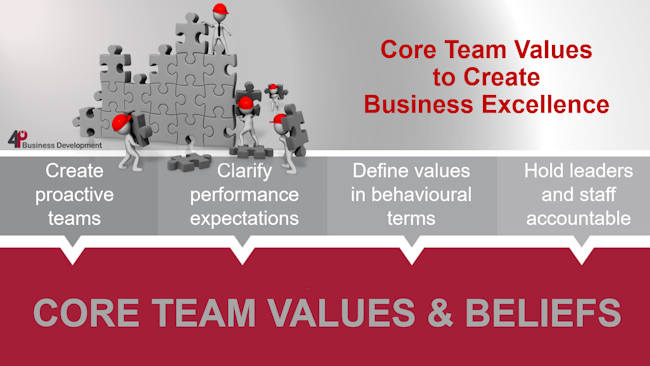
Do you want to know how how core team values can create business excellence?
copyright: 4p business development
Many of us are less interested in generically stated core values as they are rarely reflected in our team or company cultures; however, there is obviously a need for any business owner to define their values for teams to embrace clearly.
Let’s take a look at the core values required in any successful team:
People: Team members matter more than anything else, it’s about building trust-based relationships where there is specific goals orientated results, but not at the expense of the people
Change: The need for change is constant in any business and therefore it is paramount to embrace change enthusiastically, challenge the norm, question the status quo and push boundaries
Growth: to continue learning and personal development, understanding that each member of the team can always be better
Passion: Important to ensure the team maintain passion and motivation creating remarkable experiences. Operating in a relentless and driven manner and being proud of what they accomplish
Goals: set SMART challenging goals thinking BIG. A team should be happy to be responsible risk takers, try new things without losing focus on what is really important in the business, helping the business to move forward
Givers: the successful team members should be willing to give more than they receive, assisting, teaching and education each other, setting the team up for success
SMART: the team could achieve more by focusing the individual’s excellence, watch out for systems and process that can enable the team to do less; better and smarter
Fun: enjoy the work, the team and the culture, but perhaps most of all laugh and have fun while achieving
If a team can get these core values right, success and a rewarding sense of teamwork will follow.
It’s not always the task at hand that challenges teams in their progress, it’s the relationships and the little things that happen day-to-day.
“If team members can rise above the trench, they can achieve greatness!”
Then there are all the standards of performance to consider, the intangible aspects of the individual that enables a proactive team to form. There needs to be a level of common aspects of each individual ethics that fit into the business ethics:
-
Trust – don’t let the team down
-
Enrichment – enhance daily life and the team in general
-
Responsibility – behave in a fair manner
-
Community – connect with each and every team member
-
Contribution – make meaningful contributions to the team and individual members
Consider how you and your business can support a sense of shared responsibility and embrace the ‘we’ proposition across the business thereby engaging employees in more meaning manner with better outcomes.
So why should you even be considering any of this? There are obvious outcomes that your business can benefit from employee engagement and teamwork
-
Improved Morale
-
Greater Flexibility
-
Increased Innovation
-
Unified Effort
-
Quicker results
-
Improved Quality
-
Reduce Risk
Moreover, with successful teamwork, there is a good relationship between the employees. There is goodwill and understanding between the members. They also know their importance and the importance of the work that they do in relation to the success of the company.
Teamwork is really important in achieving the overall goals of a company and this ensures that the work is completed on time to a high-quality standard. The group also receives all the rewards and recognition of a job well done.
Furthermore, teamwork will eventually lead to the success of both the company and of all the individual employees involved, utilising core team values to create business excellence.
“Would you like to know more?”
You may feel like you want to learn more about how core team values can create business excellence, so do call me on 01280 700405 or click here to ping me an email and let’s see how I can help you.
Until next time …
KATH BONNER-DUNHAM
|
PS: |
If you’re looking for a partner to help grow your business, visit www.4pbusinessdevelopment.co.uk to discover how 4P Business Development can help you! |
Here’s something for you to ponder …
I and my associates at 4P Business Development would like to wish you all a happy and healthy Christmas. In order that we are able to spend time with our families and recharge our batteries, the office will be closing …

We will close our doors for our Christmas break on Wednesday 20th December and will not be re-opening until Wednesday 3rd January 2018. Something for you to ponder over the Christmas period …
“Recognise the key to your company’s success and how to motivate your staff to get them working together!”
By far the most common problems that arise in my client’s businesses are around people issues. Are you taking the time out to recognise the keys to your company’s success?
The best companies can both retain and promote the right people. They create a development plan to instil the qualities they want to see in all their current and future leaders.
Create a coaching programme to develop your team. However, be careful with a rigid programme, run by ‘by the book’ staff it can sometimes stifle creativity. To avoid this, the coach must challenge and help people to discover their limits on their own. You don’t want someone reaching the executive suite having lost all their creativity and problem-solving skills because ‘that’s the way we’ve always done it here’ do you?
Always seek out opportunities to publicly recognise individuals (of whatever level in your business) for their originality and ability to find unique solutions to problems. By praising a particular behaviour, you’re shining a spotlight on attributes you desire, significantly increasing the likelihood of replication throughout your organisation.
For long-term sustained success, it is vital to assemble leadership teams comprised of individuals who are content on both home and work fronts. If someone isn’t happy outside the office, eventually that will cross over into the workplace.
Who are your rock steady performers? Do you recognise them? Those on your team who seek out and work with the “unicorns” and lead the most profitable business units probably don’t lack in the recognition category. However, the steady, unflappable performer you can depend upon often go unnoticed. Their steadiness doesn’t command attention but it should be recognised.
Business strategy is too often focuses on financials and quarter-to-quarter progress. In defining your company’s less overt drivers and recognising those who lead in those categories, you can create more of a good thing.
“All business is results-oriented and recognition plays a big part in getting those results!”
Merry Christmas from all of us at 4P Business Development and we’ll be back in the new year to offer you more insights into your people, planning, positioning and processes, ultimately leading you to improved profitability.
Until next time …
KATH BONNER-DUNHAM
|
PS: |
If you’re looking for a partner to help grow your business, visit www.4pbusinessdevelopment.co.uk to discover how 4P Business Development can help you! |
Recruit, retain, develop and manage the best …
I believe that it should be a priority to learn to create and manage your organisation’s culture, and the people in it, as consciously and rigorously as you manage any other aspect of your business …

Good people management is key to your business reaching its goals and objectives!
copyright: 4p business development
Leadership is a lot about listening to yourself; be brave with your decisions, even if it goes against the grain. But you do have to ask yourself this:
“Do you have the right people in your business?
Too many managers employ people to match the job role that is currently in place. However, great managers seek an employee with the style and type that suits their business culture, whose skills and talent can redefine how that job is carried out, adding productivity and profitability to the bottom line.
Both people development and organisation development focuses on your actual business – its people, its teams and its leaders – and ensures that it grows in a way which supports your business and its objectives.
“4P Business Development can help you with that!”
Through two key programmes, my Organisation Development group will work with your teams and groups of leaders in your company to help produce the results you need to develop your organisation and its culture.
You can learn how you and your team can work together to raise your game with our Breakthrough Team Development programme. Establish stronger leadership and relationships in your teams and dramatically improve both the quality of your results and your experience of working together.
My team and I work with the whole of your business and you, its leader, to resolve issues of measurement, performance and role clarity, along with attitudes, beliefs, communication and values.
The second of our programmes helps you to develop your leaders through a process linked to achieving the most desired results for your business with our Breakthrough Leadership Development programme. This is specifically designed to cause changes in leadership behaviour that can be integrated into your business.
My approach is an in-depth exploration of leadership through immediate, practical and applicable projects. It is a most reliable, sustainable and cost-effective way to ensure that what is learned is relevant to your organisation.
|
|
I’ll assist you to identify four stages that all teams will go through, given time:
-
Forming: This is the awareness stage. Feelings, weaknesses and mistakes are covered up and there is no shared understanding of what needs to be done. People show little care for others’ values and views
-
Storming: The conflict stage is more risky as personal issues are opened up and the team becomes more inward looking. There is more concern for the values, views and problems of others in the team.
-
Norming: The co-operative stage, confidence and trust begin to emerge, together with a more systematic and open approach, leading to a clearer and more methodical way of working. There is greater valuing of people, clarification of purpose, establishing of objectives, systematic collection of information, considering of all options, preparation of detailed plans and progress reviews to make improvements.
-
Performing: Evidence of the productivity stage includes flexibility, leadership decided by situations, not protocol, everyone’s energy is utilised and basic principles and social aspects of the organisation’s decisions are considered.
Teams that go through these four stages successfully should become effective process improvement teams and will display:
-
Clear objectives and agreed on performance goals
-
Openness and a reduction in confrontation
-
Solid support and trust
-
Co-operation and lack of conflict
-
Good decision making
-
Appropriate leadership
-
Sound inter-group relationships
-
Individual development opportunities
|
|
I will work with your organisation to create a business that ensures that it grows in a way which supports your goals and objectives.
And I will teach you to lead in a way that makes it easy for others to want to follow, setting the right example by your own business behaviour.
“I can do that because I’m a qualified business coach and accredited PPA practitioner!”
If any of what I’ve written in the blog post resonates with you, call me on 01280 700405 or click here to send an email enquiry and let’s see how I can help you to use Personal Profile Assessments, to recruit, retain, develop and manage the best people.
Until next time …
KATH BONNER-DUNHAM
|
PS: |
If you’re looking for a partner to help grow your business, visit www.4pbusinessdevelopment.co.uk to discover how 4P Business Development can help you! |
Set powerful intentions and anything is possible …
Have you ever considered that it could be your core beliefs around your competence, worth, safety and primacy that are preventing you from achieving your goals, holding you back, and creating problems for you in your business …
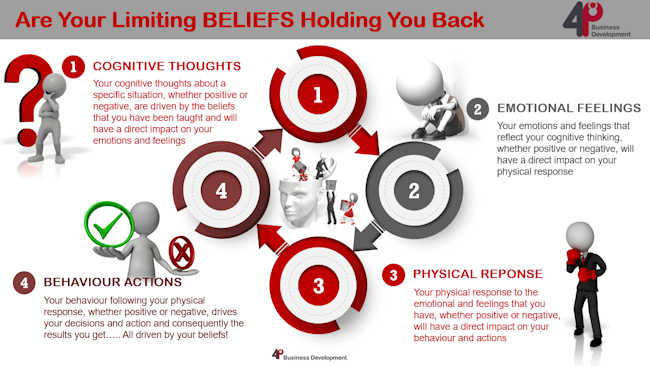
If your limiting beliefs are holding you back, then maybe I can help you?
copyright: 4p business development
The biggest difference between successful business owners and less successful ones has nothing to do with the number of challenges that they face, but the skills they have in solving those challenges.
“Positive successful people have more effective problem solving capabilities and strategies!”
They unshakably believe that they have the ability to achieve whatever goals they set for themselves and make positive choices in their lives.
You know you need support in problem-solving when you want something very much, really want to achieve your goals or want to change something in your business. Yet you continuously face roadblocks that make you feel threatened and make you feel helpless, incompetent, unworthy or just stuck.
“So what’s getting in the way, what’s holding you back?”
What is most likely stopping you and getting in your way is negative ‘schemata’ (beliefs) that can influence and hamper the uptake of new information and is based on past experiences, or negative core beliefs around what you are actually capable of achieving.
You are invariably taught these beliefs by your parents, siblings, peers, friends, associates, teachers and other people in authority when you were younger.
Albeit that these core beliefs were formed early in life, you definitely were not born with them. Most of these beliefs you will not remember learning, but they become part of you and your identity. They set your sights and establish your core fears, often keeping you stuck and feeling helpless.
Should you find that some of these limiting beliefs are getting in your way, then it’s time to consider what those beliefs are, who taught them to you and why. They are preventing you from moving forward and holding you back in your business.
The core beliefs that are most likely to get in your way are obviously the negative ones and they fall into four main categories:
-
Competence
Feeling incompetent, a fear that you cannot do things right and deep down you possibly expect to fail. This manifests itself and gets in the way of you making positive decisions that will work.
With this, often comes anxiety, stress and the fear that you will be humiliated. When you are feeling like this, it’s hard to make any decisions and the likelihood is that you will stop trying or even fail to take the first steps.
-
Worth
Feeling unworthy, a fear that you’re wrong or undeserving. When this fear is at the forefront of your thoughts it becomes scary and you are likely to take on the assumption that you are of little importance and that you will be rejected should you ask for something or attempt to make any changes.
When you are feeling like this the likelihood is that you sit back, accept the situation for what it and just hope things will get better, being totally unable to even imagine a solution that others would embrace.
-
Safety
Feeling unsafe, this is a fear that everything is uncertain and dangerous, that you cannot possibly rely on anyone or anything and even the very thought of change creates a huge predicament because you are unable to imagine what will happen.
When feeling like this, you can only imagine bad or dangerous outcomes so you tend to avoid change of any kind and when attempting to solve problems believe each and every solution to be far too dangerous.
-
Primacy
Feeling that others needs are far more important that your own and should always come first. This fear results in you generally giving in and defering to other people’s views and needs.
You are possibly extremely empathetic and, whist you believe you and your needs are not unimportant, you tend to think that others needs are far more important than your and you will give in to their desires. This belief makes problem-solving especially difficult as you find yourself unable to embrace any solution that may be any way in conflict with the needs of other people.
Should any of these core limiting beliefs be holding you back, you will need to ascertain the strength of the beliefs and how you may be able to dispute them and put in place a new effective belief.
|
|
So what is really causing these beliefs to continue and to sabotage your problem solving? This is where we can look at how your thoughts manifest into your results, positive or negative:
-
Your cognitive thoughts about a specific situation, whether positive or negative, are driven by the beliefs that you have been taught and will have a direct impact on your emotions and feelings.
-
Your emotions and feelings that reflect your cognitive thinking, whether positive or negative, will have a direct impact on your physical response.
-
Your physical response to the emotions and feelings that you have, whether positive or negative, will have a direct impact on your behaviour and actions.
-
Your behaviour following your physical response, whether positive or negative, drives your decisions and action and consequently the results you get. All driven by your beliefs!.
To begin changing any negative core beliefs, it would also help if you were to change your language and vocabulary and to ensure that you use only positive language and vocabulary and avoid all negative words such as don’t, not, no, try and hope.
|
|
Furthermore, take time out to explore some of your limiting beliefs in depth, write them down and then review the ones you are going to change, listing new beliefs you would like to develop and what would motivate you to make the changes.
Ask yourself questions around these beliefs such as:
-
Where did that limiting belief come from?
-
Why might you have been taught that belief?
-
How much do you currently believe that limiting belief?
-
How would you feel if you could change the belief?
And you will begin to realise that it is possible to dispute these limiting beliefs and put in place new positive enabling beliefs to help you move towards your goals.
“Set powerful intentions and anything is possible!”
Would you like to know more? Call me on 01280 700405 or click here to send me an email enquiry and let’s see how I can help you get rid of those limiting beliefs and move towards your goals.
Until next time …
KATH BONNER-DUNHAM
|
PS: |
If you’re looking for a partner to help grow your business, visit www.4pbusinessdevelopment.co.uk to discover how 4P Business Development can help you! |
Defining, determining and aligning …
How efficient is your business? How many tasks could be streamlined or carried out in a more efficient manner? You’ll be surprised at what I discover with my approach to your process improvement …
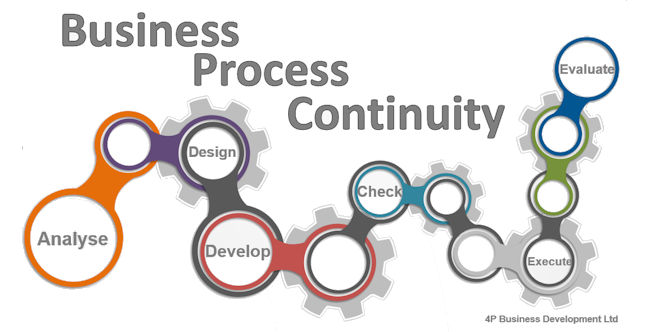
Continuous process improvement is one key to profitability!
copyright: 4p business development
It allows me to help you focus on the identification and reduction of non-value added activity in your business. This is a systematic approach to help your organisation optimise its underlying processes to achieve more efficient results.
“The best processes allow you to take control of your business and deliver excellence!”
I’ll listen carefully to your view of the business, the history behind the current business plan and structure, the areas which are currently successful, those which you would like to improve, and your business goals and objectives for the future.
Business process improvement works by:
Defining the organisation’s strategic goals and purposes (who are we, what do we do, and why do we do it?)
Determining the organisation’s customers or stakeholders (who do we serve?)
Aligning the business processes to realise the organisation’s goals (how do we do it better?)
It’s very important to scrutinise your business processes to identify how and where they can be streamlined, whether process order can be improved, if existing tools can be better utilised and where investment in new systems or equipment can be justified.
Continuous process improvement has been described using a number of models. One of the most popular is the system approach with five phases in the model:
-
Analysis Phase – Identify areas of opportunity and target specific problems. These areas and problems are based on team brain-storming sessions, process definition sessions, recommendations forwarded to the team by organisational members, and other various analysis techniques.
-
Design Phase – Generate solutions through brainstorming sessions. Identify the required resources to implement the chosen solution and identify baselines to measure.
-
Development Phase – Formulate a detailed procedure for implementing the approved solution.
-
Implementation Phase – Execute the solution.
-
Evaluation Phase – Build measurement tools, monitor implementation, and evaluate measurements to baseline.
However, the success of continuous process improvement within your business also requires you to take the time to identify issues with existing processes and systems and take corrective action.
“Identify areas of non-conformance and rectify them as soon as possible!”
How often should you evaluate and follow up to ensure the processes are working? Basically, wait a suitable amount of time and make sure the problem doesn’t recur. If it does, you should be questioning if you have found the actual cause.
On a final note, remember:
Corrective action is used when you are reacting to a problem that has already happened.
Preventive action follows the same process except that it is applied to a problem before an issue occurs.
Get the right processes and systems in place and your business will be more efficient and allow you to create greater profitability.
If you would you like to know more about anything I’ve mentioned here, call me on 01280 700405 or click here to send over an email enquiry and let’s start a conversation about process improvement for your business.
Until next time …
KATH BONNER-DUNHAM
|
PS: |
If you’re looking for a partner to help grow your business, visit www.4pbusinessdevelopment.co.uk to discover how 4P Business Development can help you! |
Or, how I can help you to bite that bullet …
I’m Kath Bonner-Dunham and for 40 years I’ve specialised in sales and marketing, operations and management. It seemed like a no-brainer to offer that experience to other passionate business owners …

I challenge you, I ask those bloody difficult questions (BDQs) and I advise you!
copyright: 4p business development
During that time, I gained a business degree from London Thames Valley University and an additional coaching and mentoring degree at Oxford Westminster, That led me to start a successful business in Essex.
“I went on to become the General Manager of a £12M company in Maidenhead!”
So you can understand why, after helping so many companies to grow and thrive, it was natural for me to lead 4P Business Development and work more formally with passionate business owners who want to reach the next level of success.
So do you have questions like:
Who can I bounce ideas off when I need to?
Who will question the status quo and ask me questions I have never considered?
What is your plan to manage emergencies that could affect your business?
Who will challenge me if I’m going in the wrong direction?
How can I find the right experts to support me and my business?
How can I get more from my people and increase profitability?
I don’t know where to find my best clients?
What’s my plan to manage emergencies that could affect my business?
Well, I’ve got the answers for you!
It’s often relatively easy to identify the issues holding a business back. What’s not always so easy is to ‘bite the bullet’, to make the necessary changes, and to do it in a way which leaves the business and its people in better shape than before.
“And remember, it doesn’t just happen!”
The transition process needs to be managed over time to enable everybody in the organisation to accept and work comfortably in the ‘new’ set up. I’ll listen to you, help you to look at your situation holistically, and advise you on ways to grow the profit over the turnover in your business.
I work with Lesley Long to help grow her business and she said of me:
”Kath is a dynamic, inventive and challenging business coach able to adapt her style to suit her client’s needs and their preferred way of working. With Kath’s help, I was able to push aside limiting beliefs that were holding me back and form a clearer vision of what I want for my business and myself. I now have a personal game plan in place and am working steadily towards putting my business strategy into place.”
And Michael C. Cody, a fellow coach said:
”Kath Bonner-Dunham gets results. She has the powerful ability to cut through the distraction, noise, and chaos that beset so many business owners today. Her refreshingly clear communication and straight-to-the-heart approach are a gift to her clients. The value of her input and her results cannot be overstated.
Her compassion shines through in her commitment to helping clients achieve their excellence. Kath is brilliant and has my deepest respect and endorsement. If you want results in your business and are sick of empty motivation, then you owe it to yourself and your business to work with Kath Bonner-Dunham.”
So, I challenge you, I ask those bloody difficult questions (BDQs) and I advise you. And I’ll prompt you to build on areas of strength in both yourself and your business, enabling you to achieve your full potential.
If you want the confidence and skills to delegate to others and give them the permission and authority to shine, and bring innovation and inspiration into your business then we must talk.
“I’ll support you in making those difficult decisions, and challenge you to achieve your highest aims and aspirations!”
You know you owe it to yourself and your business to invest in coaching, mentoring and advice with 4P Business Development, so why not give me a call on 01280 700405 or click here to ping over an email enquiry and let’s talk.
Until next time …
KATH BONNER-DUNHAM
|
PS: |
If you’re looking for a partner to help grow your business, visit www.4pbusinessdevelopment.co.uk to discover how 4P Business Development can help you! |
Under promise and over deliver …
Do you really know just how happy your clients are? Do you deliver what you promise in a timely manner? Or do your clients perceive that you really do not care?
In genuinely customer-focused businesses, customer delight is part of the culture!
copyright: 4p business development
Did you know that only 7% of existing customers that leave you, leave because of the price, whereas 63% leave because they perceive that you do not care about them?
In today’s fast-moving, competitive market, it is more important than ever to ensure customer delight, gaining a competitive advantage and staying ahead of the game.
In genuinely customer-focused businesses, customer delight is part of the culture and make-up of the company. It’s the paradigm, “the way we do things around here”.
It’s about exceeding customer expectations, and in many organisations that can be as simple as:
-
Creating the WOW factor
-
Listening relentlessly
-
Fulfilling the need
-
Delivering to specific standards
-
Timeliness and quality of service
So, do your employees have the customer service skills required of them to ensure customer delight and gain that vital competitive advantage?
A lot of patience
When dealing with customers on a daily basis, stay patient when they come to you stumped and frustrated, but be sure to take the time to honestly figure out what they want.
Good focus and attentiveness
The ability to really listen to customers is crucial when providing excellent service. What are your customers telling you without actually saying anything?
Clear communication skills
When it comes to relaying essential points to customers, keep it clear, simple and leave nothing to doubt.
Product knowledge
Without knowing your products inside out and back to front, you won’t understand how to help customers when they have problems.
Use of positive language
The language you use is a hugely important part of persuasion, and customers will create perceptions about you based around the words you use.
Good acting skills
Every good customer service representative will have the acting skills they need to maintain a cheery persona when dealing with grumpy people.
Excellent time management
Don’t spend time going above and beyond for a customer if you’re just going to end up wasting both of your time.
Ability to ‘read’ a customer’s mood
Look and listen for subtle clues about their current mood, patience level and personality then mirror the way they are talking to you.
A calming nature
The best customer service reps know that they cannot let an angry customer makes them lose their cool. It is their job to be calm for the customer who thinks the sky is falling in.
Very goal oriented
The goal is to delight the customer. Sometimes, this means making decisions on the fly, so support the caller with pre-planned options and guidelines for their use.
Able to think outside the box
Sometimes, you’re going to get a customer with an issue that hasn’t been heard of before, and there are no guidelines to deal with it. This is when you need to be empowered to make a decision on best how to help the customer and run with it.
Good at persuasion
It’s not about making a sales pitch in every email or call, but it’s about not letting potential customers slip away if you can’t create a compelling message that what your offering is worth buying.
Determined
A great work ethic and a willingness to do what needs to be done is a crucial skill when providing the kind of service that people talk about.
Good at closing
Ending a conversation with a happy customer is essential in the drive for customer delight. Ok, maybe you can’t solve every issue there and then, but you can strive to get as close as possible.
A willingness to learn
Whether it’s building products, marketing businesses, or helping customers, if you don’t invest in yourself you will get left behind by the people who are.
It’s far more than just managing expectations. Customer delight occurs when a business delivers a customer a strong, positive experience that exceeds their expectations.
This positive emotional response is what leads to repeat buying, loyalty and word-of-mouth referrals. Delighted customers are five times more likely to repurchase from you than just satisfied customers.
According to the American Express Customer Service Report, more than 50% of UK customers will spend more on products and services if the service experience was guaranteed to be first class.
It shows that on average, UK consumers will pay a premium of 7% for the privilege of good customer service and 70% state they would do more business with an organisation that offered decent customer care.
“Does working with your team to encourage customer delight now sound more attractive to you?”
Would you like learn how to increase your profitability, customer retention, repeat business and competitiveness in today’s market of increasing customer expectations?
You may feel that now is the time to give me a call on 01280 700405or click here to ping me an email and let’s see how I can help you.
Until next time …
KATH BONNER-DUNHAM
|
PS: |
If you’re looking for a partner to help grow your business, visit www.4pbusinessdevelopment.co.uk to discover how 4P Business Development can help you! |
Complicated, but doesn’t need to be confusing …
One of the main reasons people give for leaving organisations is that they have stopped growing. Growth brings energy, vitality, life and challenge so without growth, you’re just going through the motions …

Employee engagement is vital for any organisation that wishes to grow!
copyright: 4p business development
You need to create a culture of learning and growth within your business and you will maximise the talent of your team and see a greater return on your investment.
Making employee engagement a positive experience can prove to be extremely attractive, providing:
Enhancement
Efficiency
Experience
Effectiveness
Transformation and growth
Attracting the best people to your business and subsequently keeping hold of them is one of the biggest challenges for any growing business.
Engaging with your employees is a key factor to motivation and retention. People who feel valued as an individual and are included in the company’s goals, will work harder, smarter and feel appreciated.
Employers are finding that top candidates are hard to find, expensive and often snapped up by high-profile blue-chip companies. Maximizing the skills available to you within your own organisation is far more beneficial and profitable.
“Have you heard about the three Es?”
Employee Engagement is often confused with the idea of employee satisfaction. While the two are related, they are unique. Satisfaction has to do with contentment, while engagement is about connection.
We may see an employee who is satisfied with their salary and the people they work with, but that doesn’t mean they are engaged. An engaged employee is someone who is more than satisfied. They are inspired, interested and committed to their work.
In some ways, being engaged can be considered the opposite of being burnt out. A burnt out employee feels cynical about their work, but when employees are engaged, they are positive about what they do and how it contributes to their personal and company-wide goals.
Employee Experience begins the moment someone starts the application process at your organisation to the day they take their exit survey after leaving the company. This experience isn’t static. In fact, it can change from day to day.
While employee experience can and will fluctuate over time, it’s useful to think about it in terms of key milestones in the overall employee lifecycle – candidate onboarding, training, exit, alumni.
Employee Effectiveness as the next generation of performance reviews. They both communicate how an individual or team is doing, but employee effectiveness also empowers individuals and teams to drive their own development.
It’s not about telling them what they need to do, but giving them the feedback and the resources to decide their own career path. When the right criteria and metrics are used, employee effectiveness also eliminates the biases that often occur with subjective performance reviews.
Some of the aspects you may wish to give your consideration to are:
How to increase employee engagement and grow your workplace culture
How to understand the employee experience at your workplace and why it matters
How to conduct performance reviews to provide meaningful feedback on employee effectiveness
How to conduct an employee survey
Untangling what employee engagement really means can be complicated, but that doesn’t mean it needs to be confusing. Once you understand how it can bring benefits to your organisation, you can start to build a feedback platform to gain better insights about your employees.
“And with that information, you can act to make your company the best it can be for everyone!”
If you’d like to learn more about employee engagement and how it can really help you to grow do give me a call on 01280 700405 or click here to ping me an email and let’s see how I can help you.
Until next time …
KATH BONNER-DUNHAM
|
PS: |
If you’re looking for a partner to help grow your business, visit www.4pbusinessdevelopment.co.uk to discover how 4P Business Development can help you! |
A strategic process for business success ..
One of the secrets to business success is the right pricing. Price your products for your target market and that can enhance how much you sell, creating solid growth …
f your price isn’t right then you’re going to be losing money!
copyright: 4p business development
Get your pricing strategy wrong, and you may well create problems that your business may never be able to overcome. The first thing you have to understand is that the price you get to charge is a function of your ability to sell and nothing else.
For some companies, the pricing strategy for products and services is based purely on a combination of covering costs and making a profit. Smart businesses understand that you can fail to gain new customers just as easily because your price is too low.
“Did you know it’s 6 times more expensive to win a new client than to retain an existing one?”
When customers leave you, it has very little to do with how much you charge, it is much more likely to be that they perceive that “you do not care”, so never be afraid of raising your prices.
Raising your prices means you can:
improve your profit margins to help grow your business quicker
don’t need to sell more products
determine A-grade customers from D-grade ones
distinguish yourself from competition and their similar rates
make a statement about your product/service quality
focus on other areas of improvement
Customers who are disgruntled about price increases are the minority, and any losses from leaving customers can be compensated by increased profit margins from your new higher prices.
Reviewing your pricing should be done at least once a year. Remember, as costs go up your profit goes down, so if you don’t put up your prices then eventually, you’re not going to make any profit at all and, well, you know what happens to your business then?
“Don’t be greedy though. Any price increases you make need to be easily explained to your customers!”
If you’d like to talk about your profitability, or indeed review your business to see what your pricing should really be, you can call me on 01280 700405 or click here to ping me an email and let’s see how I can help you.
Until next time …
KATH BONNER-DUNHAM
|
PS: |
If you’re looking for a partner to help grow your business, visit www.4pbusinessdevelopment.co.uk to discover how 4P Business Development can help you! |
Do you want to be?
It’s time for me to stick my neck out a tad here and say that in the field of Business Coaching and Mentoring I consider myself to be an expert. So what makes me an expert you may ask?

If you want to be an expert in your field, you’re going to need help to get there!
copyright: 4p business development
It’s not just because I have been coaching most of my working life, (reflection is a beautiful thing), but it’s more about the fact that I have totally immersed myself in the field of Business Coaching. I’ve gathered as much knowledge as possible and applied it wherever possible.
I have 45 years experience of running a business, I hold a business degree and a degree in coaching and mentoring. I now feel that it’s really paying off with a level of skills, knowledge, expertise and qualifications that few others possess.
“What is expertise? Having a great deal of knowledge or skill in a particular area!”
So how does that make me feel? I experience an elevated level of respect from my colleagues and clients. When I am coaching I am taken seriously, I am sought out by others to add my two-penneth worth in topics for debate, I feel empowered and engage in deliberate practice.
“What is an expert? A person who is very knowledgeable about or skilful in a particular area!”
Experts know their stuff. They have vast pools of knowledge, built up over many years, and can be relied upon to provide accurate, insightful answers to even the toughest questions within their field of expertise.
They have an abundance of wisdom, experience, and capability-and they aren’t afraid to use it.
According to The Harvard Business Review, real expertise must pass three tests:
It must lead to performance that is consistently superior to that of the expert’s peers.
Real expertise produces concrete results.
True expertise can be replicated and measured in the lab. “If you cannot measure it, you cannot improve it.”
Becoming an expert overnight just isn’t going to happen. You are going to have to put a lot of work and dedication into becoming an expert at anything.
“And it’s not all about talent!”
Thorough research has shown that individuals identified as ‘ordinary’ rather than ‘talented’ can become exceptionally skilled in many fields with the right coaching. However, continued improvement beyond a certain point takes motivation, time and know-how … and many people lack all three.
Once you are seen as an expert in your particular field, it can, of course, open up the door for bigger and better business opportunities.
Every article I have read about becoming an expert has one thing in common: they all say you must employ a mentor or coach. So if you would like to be an expert in your field start considering who would be your best mentor or coach and take action today.
Just imagine actually feeling like the confident authority you dream of becoming? See yourself talking to others and not feeling the slightest twinge of anxiety as you tell them why you are an expert in your field.
“Would you like to know more?”
I am an expert business coach and mentor who has enough knowledge, skills, expertise and qualifications to help others confidently.
If that resonates with you, call me on 01280 700405 or click here to ping me an email and let’s see how I can help you to become an expert too.
Until next time …
KATH BONNER-DUNHAM
|
PS: |
If you’re looking for a partner to help grow your business, visit www.4pbusinessdevelopment.co.uk to discover how 4P Business Development can help you! |
Working with you to create your vision …
There are all types of coaches: a tennis coach, golf coach, swim coach, music coach, executive coach, and, of course my personal favourite, a business coach …
If you’ve ever wondered how a business coach can help you, read on!
copyright: 4p business development
I am sure there was no hesitation when you learnt to drive. You will have employed the best driving instructor and paid them to teach you how to handle a car safely.
“So why not hire the best coach and get them to teach you to ‘drive’ your business?”
A business coach never does the work for you, but here’s how a coach can help launch you and your business to the next level and to guide you to achieve your long term goals and aspirations.
”Why do I have a business coach? It’s quite simple: to have someone who understands my beliefs and can challenge my thinking by asking those powerful questions, as well as being there to brainstorm and bounce ideas off. Every Olympian has a coach to help them be at the top of their game, and I want to be at the top of mine”
Roger Eddowes – Chartered Accountant
A business coach is not a therapist yet a qualified business coach, one that is trained in a repeatable business-building methodology and had qualifications in business, coaching and mentoring really can make all the difference.
“No matter what stage your business is at, a business coach can get you to work harder and progress faster than you would on your own!”
From providing a much-needed ego check to helping expand your network, a business coach can give you both the tools and perspective you need to go from where you are now to where you aspire to be.
”We chose to work with Kath and the impact of her coaching is game changing. It can bring clarity to what seem like impossible situations, an increase in the ability to communicate in a productive and effective manner, and confidence in areas where it is needed most.”
Kate Cross – Wedding Venue Owner
Based on their own experiences, 10 successful founders from the Young Entrepreneur Council determined the top 10 benefits to hiring a business coach:
-
You’ll go outside your comfort zone.
-
You’ll get personal attention from someone who knows your business inside and out
-
You’ll finally have someone who isn’t afraid of correcting you
-
You’ll learn how to make your ideas a reality
-
You’ll gain a needed confidante
-
Your networking opportunities will skyrocket
-
You’ll make more money
-
You’ll develop self-confidence
-
You’ll be held accountable for what really matters
-
You’ll hear unbiased opinions
One great thing about having a business coach is that they know more about you than your business and will likely have no biases without your industry or company. This provides a great sounding board for unbiased discussions based on your concerns as a business owner.
”Working with Kath on our business is like having another Director on the Board who brings a huge wealth of experience, without the emotions attached to running your own business.
Having worked with Kath for over 5 years, we not only make much better business decisions and are better employers as a result of her guidance, but also refer to her if we need a second opinion.
I know that we would not be running the professional and dynamic companies that we are today without her input and her role has evolved as we have developed our businesses and our business acumen. ”
Jo & Anthony Robinson – Boutique Catering
Good business coaches can lead founders to Aha! moments and uncover solutions that people close to the business may overlook. Chose the right coach, one with business experience and coaching qualifications, and they will:
-
Be your confidant. You can tell your coach things you wouldn’t tell others, because a coach is trained to understand and be non-judgmental.
-
Encourage you to see your blind spots. A coach is perfectly poised to perform this critical function.
-
Question the status quo and provide objective feedback. A coach has your best interests in mind in providing feedback and counsel to you.
-
Provide an alternative set of eyes. Even the top performers in the world have coaches to help them see what they themselves can’t see.
-
Hold you accountable. Your coach can help you take on more responsibility by having you report weekly on your accomplishments and initiatives.
-
Be that alternative sounding board. As you hear yourself have a conversation new personal realizations emerge.
-
Be source of creative ideas. You can brainstorm and try out new ideas, behaviours and mental processes as your coach provides a safe place to experiment.
-
Work with you to create your vision. Your coach can assist you in developing your medium and long term plans for success based on your personal values, personal strengths, background and assets.
-
Celebrate your successes and be a source of strength when you fail. Your coach can be a supportive and nurturing source of energy.
-
Help you process life. Life is a process and a good coach can assist you in reviewing and reframing what happens in your business and your life!
”Kath gets results. She has the powerful ability to cut through the distraction, noise, and chaos that beset so many business owners today. If you want results in your business and are sick of empty motivation, then you owe it to yourself and your business to work with Kath Bonner-Dunham.”
Michael C Cody – Certified Coaches’ Coach
If you feel motivated to learn about how coaching can help you in your business then do give me a call on 01280 700405 or click here to ping me an email and let’s see how I can help you.
Until next time …
KATH BONNER-DUNHAM
|
PS: |
If you’re looking for a partner to help grow your business, visit www.4pbusinessdevelopment.co.uk to discover how 4P Business Development can help you! |
And a new website too …
Wow! I have a new brand and a new website to go with it. It’s the same company name and I’m still using a red/grey/black colour palette, so it’s still ‘brand me’. How exciting …

I’m pleased that my trusted partners came together to create ‘brand me’!
copyright: 4p business development
I have to thank so many people for all of their hard work, attention to detail and support to get me to this stage. And yes, I am very happy with the end result.
“So, why are so many people so often unhappy with their new website?”
They moan about this thing being in the wrong place, about that function not doing what they want it to do, about the level of service they are getting (or not getting) and how much it costs to build and maintain it online.
Well, it’s my personal opinion that it is so very often their own fault. They may not have communicated their needs fully. They probably haven’t explained all about them and their business and maybe not even employed the correct people to do the job for them.
So, who do you need in order to get the brand, website and printed materials you aspire to, in the time you would like it, and ensure it all fits the core values of you and your business?
-
Web designer?
-
Graphic designer?
-
Photographer?
-
Videographer?
-
Wordsmith?
-
Printer?
Always use trusted partners or experts that have been referred to you. You will find the list of my own trusted partners on my website by clicking here.
A brand can be defined as a seller’s promise to consistently provide a unique set of characteristics, advantages, and services to the buyer. It is a name, term, sign, symbol or a combination of all these planned to differentiate the goods/services of one seller or group of sellers from those of competitors.

And remember that every human being is a brand too. The way you socialize, who you know, what you say in real life and online, how you present yourself to the outside world, as well as the beliefs and values you project.
Find out more about branding:
Don’t forget to click through to visit my new website to see my new branding and leave a comment below with your thoughts.
“Would you like to know more?”
If you’d like to talk about creating your own ‘brand me’ and how it can help with your business’ profitability, do call me on 01280 700405 or click here to ping over an email and let’s see how I can help you.
Until next time …
KATH BONNER-DUNHAM
|
PS: |
If you’re looking for a partner to help grow your business, visit www.4pbusinessdevelopment.co.uk to discover how 4P Business Development can help you! |
Working towards your goals …
Wherever you look, the importance of teams is obvious. From sport to medical to business, motivated people who work together well is all important. But remember, the best teams aren’t simply there for the money …

The importance of teams that work together well can’t be understated!
copyright: 4p business development
The heart of a good team is the leader. It doesn’t matter whether you’re a CEO running a top management team or a supervisor with a handful of people you’re responsible for, the team meshes firstly around the leader and secondly around the task at hand.
“And that leader must lead!”
He or she needs to stamp their authority on the team. Not with negativity, a blame culture or an iron fist, but with positive encouragement, with congratulations and with a listening ear to address each members personal motivation.
They must also keep an eye out on the processes and systems they use to ensure the team is working to the best of their abilities. Should a team member be struggling or a process/system creating a bottleneck, then the leader must step in to resolve the issue.
The team must also know that the leader is in charge and the leader must know that the buck stops with them. They are the ones that will be blamed should the team fail at a specific task, so it’s up to them to ensure the team do it right, first time, every time; they can pass responsibility downward, but not blame.
As for the task at hand, to do that successfully, a combination of personality, natural talent, training and teamwork is needed. Be it a football match, a life-saving operation or the meeting of targets and KPIs for managers and business owners further up the organisation … the team must work together at all times.
“And this is where I step in with my years of experience running businesses, building teams and coaching leaders!”
Not only can I help you find the right people, but I can define the processes and systems that need to be followed so that the team can work at its best. I can train the team leaders in the art of leading and will I help senior management define the KPIs they need to see to ensure the organisation is running profitably.
Remember that even the smallest cog in the machine is as important as the biggest and they all need to be oiled to work smoothly. Each team needs:
-
The right personalities
-
The right talents, skills & experience
-
A strong, well-motivated leader
-
Clearly defined processes and KPIs
-
Efficient systems in place
-
Regular evaluation
-
Ongling training and support
At 4P Business Development, we excel at team building and we’d love to help you boost your profitability by ensuring your teams work efficiently towards to goals of your organisation.
“Would you like to know more?”
The importance of teams can’t be overstressed so if you feel you need some help then do call me on 01280 700405 or click here to ping over an email and let’s get your teams working efficiently.
Until next time …
KATH BONNER-DUNHAM
|
PS: |
If you’re looking for a partner to help grow your business, visit www.4pbusinessdevelopment.co.uk to discover how 4P Business Development can help you! |
Motivate your team and boost productivity …
The Trait Emotional Intelligence Programme educates you on how your team understands and manages their emotions, how well they interpret the emotions of others, and how to best manage relationships …
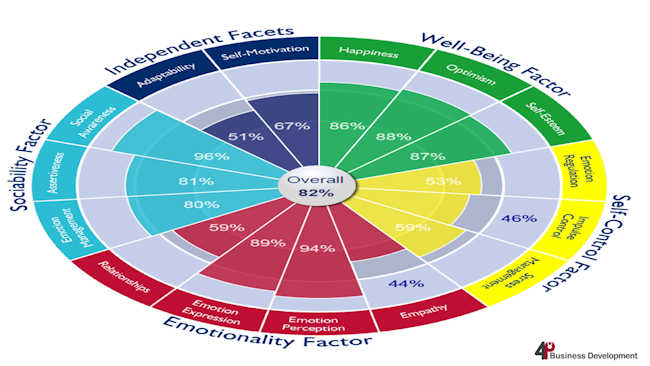
Emotional Intelligence assessments can Motivate your team and boost productivity!
copyright: 4p business development
It can be formally defined as a constellation of emotional perceptions assessed through questionnaires and rating scales. Emotional Intelligence essentially concerns our perceptions of our inner world.
Emotionally intelligent people:
Have self-awareness
Are excellent communicators
Can adapt their behaviour to a variety of situations
As a result, they are more likely to have the edge they need to lead, manage, and perform in today’s competitive and complex marketplace. They are also adept at dealing with stress, low morale, conflict and change.
The Emotional Intelligence Assessment will help you identify the external candidates and employees who can thrive in a dynamic, changing environment.
It can also determine the areas your people need to develop going forward. And because emotionally intelligent managers have fine-tuned people management skills, their teams tend to perform well, they’re motivated and have high morale, which contributes to staff loyalty and great retention.
|
|
This assessment provides you with a report and will help you answer questions, including:
-
How aware is this person of their strengths and limitations?
-
To what level does this person modify their behaviour to suit changing situations?
-
How does this person react to pressure?
-
Can they control their impulses when under stress?
-
How sensitive is this person to other people’s emotions?
-
Do they excel at developing relationships?
-
How self-motivated and adaptable is this person?
It will help improve communication and personal engagement, develop a more motivated team, and generate higher productivity.
Further Reading about Emotional Intelligence:
At 4P Business Development, my team use a number of different personal Emotional Intelligence tools centred around the Trait Emotional Intelligence Programme. I am an accredited and qualified practitioner in EI through Thomas International.
“Would you like to know more?”
If you would like to find out more about Emotional Intelligence Assessments and to explore if they would help you in your business, do call me on 01280 700405 or click here to ping over an email and let’s see how I can help you.
Until next time …
KATH BONNER-DUNHAM
|
PS: |
If you’re looking for a partner to help grow your business, visit www.4pbusinessdevelopment.co.uk to discover how 4P Business Development can help you! |
Employing the wrong candidate could be a disaster …
Recruiting the right people is all important if you want to build a successful business. We use Personal Profile Analysis to identify the right roles for each individual and recommend ways to retain, motivate and develop them …

Personal Profile Analysis can help you recruit the right people!
Copyright of 4p business development
The more you know your people, the more you can effectively control and manage your business. Our techniques and tools allow us to develop deep insights about your team, where their skills lie and what engages and motivates them to work at their best.
“When you truly know your team, you can adapt your communication style to ensure it is received in the best way to deliver results!”
At 4P Business Development, we use a number of different personal profiling tools. I’m an accredited and qualified practitioner in Personal Profiling through Thomas International.
Used by over 5,000 UK businesses, the Personal Profile Analysis (PPA) takes less than 10 minutes and is based on multiple choice questions.
Now you may wonder what you can reveal about a person in that time, but you’ll be quite surprised on what you can see when you shine a light on someone’s psyche.
In her article for the Telegraph, Olivia Goldhill said the following about taking a PPA:
“Before the test, I had strong doubts that a multiple-choice quiz could shine any light on my complex inner psyche. Seven minutes and one report later, I don’t seem so inscrutable after all.
The PPA itself was an underwhelming experience, made up of 24 questions that asked me to choose which of four adjectives most and least describe my behaviour in the workplace.
One question asked me to choose between good mixer, cultured, vigorous and lenient, while another included jovial, precise, courageous and even-tempered.
As any one of these adjectives could apply to me in different situations, I soon ended up clicking through rapidly without giving my answers much thought.
I did not expect to receive a seven-page report, with a more accurate and insightful portrayal of my behaviour than my own mother could give.”
Simple, yet revealing!
If you hire people just because they can do a job, they’ll work for your money. But if you hire people who believe what you believe, they’ll work for you with their blood, sweat and tears.
But also remember, the cost of having the wrong person in the team is too high; in fact, it can become a complete disaster. Don’t leave it down to fate, let my team and I help develop your people and drive your growth.
Further Reading about Personal Profile Analysis:
If you would like to find out more about Personal Profile Analysis or if you feel this process would help you in your business to build and develop a great team, do call me on 01280 700405 or click here to send me an email and let’s see how we can help you.
Until next time …
KATH BONNER-DUNHAM
|
PS: |
If you’re looking for a partner to help grow your business, visit www.4pbusinessdevelopment.co.uk to discover how 4P Business Development can help you! |
Turning your analysis on its head …
When I discuss business models with my clients, they all look at me with a blank face. Why on Earth would they want to do that, what use is it to their business? They’ve got far better things to do with their time …

TOWS goes beyond SWOT and turns your analysis on its head …
copyright: 4p business development
So many business owners believe that they understand what a SWOT analysis is and place little value on it. Perhaps that is because they may have omitted to carry out an in-depth analysis, but more likely, they have never realised the positive return on the time invested because they have never converted it to a TOWS matrix.
“Last week, I introduced PESTLE and the results of that exercise should feed directly into a SWOT analysis!”
Like so many business models, a SWOT analysis is an absolute waste of time completing just for the sake of it. There has to be a strategic outcome that you can apply to your business in order to reap the benefits.
So what exactly is a TOWS Matrix then?
Well, it’s where we take the results of a SWOT analysis and turn them on their head, translating into a working document and business plan.
Often, a criticism of a SWOT analysis is that it doesn’t show the relationships between the different factors. As an example, a specific threat might show a weakness as much more significant.
Whereas a TOWS analysis will look to match internal and external factors to help identify strategic ideas an organisation could pursue. It helps you to see how it can take advantage of opportunities, reduce threats, overcome weaknesses and exploit any strengths.
Once you’ve listed your ideas in each inner quadrant, evaluate the options you’ve generated and identify the ones that give the greatest benefit and best achieve your goals.
This helps you identify strategic alternatives that address the following additional questions:
-
Strengths and Opportunities (SO) – How can you use strengths to take advantage of opportunities?
-
Strengths and Threats (ST) – How can you benefit from strengths to avoid threats?
-
Weaknesses and Opportunities (WO) – How can you use opportunities to overcome weaknesses?
-
Weaknesses and Threats (WT) – How can you minimise weaknesses and avoid threats?
Evaluate any options you’ve generated and identify any that give your business the greatest benefit, and that will best achieve the mission and vision of your organisation. Add these to the other strategic options that you’re considering.
“You can find a copy of both the SWOT and TOWS matrices on my website!”
For assistance with either TOWS or SWOT, and in creating the perfect plan for your business, do call me on 01280 700405 or click here to send me an email enquiry and let’s see how I can help you.
Until next time …
KATH BONNER-DUNHAM
|
PS: |
If you’re looking for a partner to help grow your business, visit www.4pbusinessdevelopment.co.uk to discover how 4P Business Development can help you! |
Using models to help strengthen your business …
Today we are going to look at PESTLE Analysis to understand how you can minimise the risks your business faces, eliminate threats and maximise opportunities …
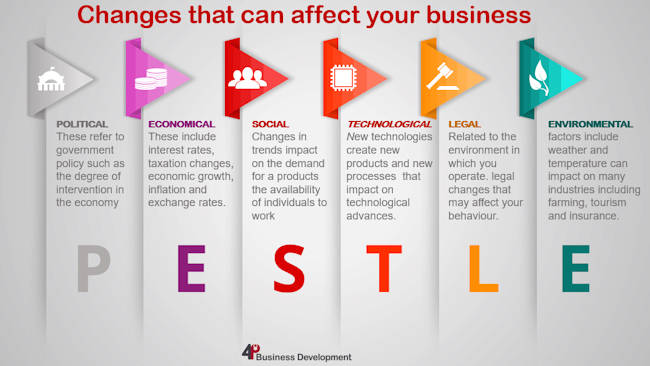
PESTLE Analysis can help minimise risks, eliminate threats and maximise opportunities!
copyright: 4p business development
Do you have a business plan? Have you carried out the general assessments in order to understand exactly where your business sits in the market? Do you know what risks from external factors may affect you and your business? PESTLE Analysis is a framework used to scan your organisation’s external macro-environment.
“But why would you want to bother with that, you may ask?”
So many people start a business because it’s something they are really good at, or the products are ones they particularly like, frequently without any strategy or planning. Probably, they have not even thought about the market and if there is a place for them in it.
Take the time to conduct a PESTLE Analysis as it gives a bird’s eye view of the whole environment from many different angles that you should keep track of while contemplating on specific ideas, plans and strategies.
|
|
To begin with, there are a number of crucial questions you need to ask while carrying out this analysis to keep you moving forward and to give you an idea of what things to keep in your mind:
-
What is the political situation of the country and how might it affect my business?
-
What are the prevalent economic factors and situation may affect my business?
-
How much impact does culture have in the market and how may that affect my business?
-
What technological innovations are likely to pop up and affect the market structure?
-
Are there any current legislations that regulate the industry or can there be any change in the legislations for the sector that I am working in?
-
What are the environmental concerns for the industry sector?
So what next? Ideally, you should be considering all the factors from both the view of threats to your business, and also from the view of opportunities that may be open for you to realise greater potential.
|
|
It can be helpful to create a matrix to capture this information and allow further analysis:
-
Political Factors – Factors that may determine to what extent the Government may influence specific industry sectors or the economy:
-
Government stability
-
Tax regulations
-
Trade restrictions
-
Dominant political ideology
-
Bureaucracy issues
-
Fiscal policy
-
-
Economic Factors – Factors that determine of your economic performance which will directly impact your profits:
-
Inflation
-
Taxes & duties
-
Exchange rates
-
Finance credit
-
Cost of living
-
GDP
-
-
Social Factors – Factors around personal attitudes, core values and beliefs together with demographics:
-
Social mobility
-
Education
-
Ethics & religion
-
Historic issues
-
Demographics
-
Attitude & beliefs
-
-
Technological Factors – Factors including the rate of the rapid technological changes and innovation and how that may impact on your business:
-
Rate of change
-
Research & development
-
Production efficiency
-
Quality
-
Pricing
-
Intellectual property
-
-
Legal Factors – Factors, internally and externally, that when changed will affect your business, cash flow and profitability:
-
Taxation
-
Employment
-
Advertising
-
Heath & safety
-
Compliance
-
Regulatory bodies
-
-
Environmental Factors – Factors that may include geographical, and global changes in addition to aspects such as tourism and agriculture and how that may impact your business:
-
Infrastructure
-
Energy availability & cost
-
Disposal of materials
-
Legislation
-
Cynical weather
-
Ecological consequences
-
|
|
Once you have completed the PESTLE Analysis matrix, then it’s time to begin to use the information gathered, understanding the potential threats to the business’ ongoing profitability and to assist in identifying future difficulties you may likely face so that action can be taken to help avoid and eliminate their effects.
Similarly, the matrix from a positive viewpoint can enable your business to be aware of opportunities that may become available in the future.
Analyse the findings and identify strategic options to minimise threats and maximise opportunities.
It is important for you to decide which trends should be monitored on a regular ongoing basis and how best to incorporate this information into your strategic planning. And who is going to be responsible for keeping the PESTLE Analysis up to date?
The results of your PESTLE Analysis should feed into a SWOT Analysis as it helps to determine the threats and opportunities represented by macro-environment forces that the organisation usually cannot control.
“Would you like to know more?”
If you’d like to talk to me about PESTLE Analysis, coaching for you and your business or need someone to ask those bloody difficult questions then do get in touch. Call me on 01280 700405 or click here to send over an email enquiry and let’s see how I can help you.
Until next time …
KATH BONNER-DUNHAM
|
PS: |
If you’re looking for a partner to help grow your business, visit www.4pbusinessdevelopment.co.uk to discover how 4P Business Development can help you! |
And eliminate time wasting activities …
If you’re finding you’re swamped in your business, you can regain control of your valuable time by eliminating the things that get in the way of your productivity and profitability …
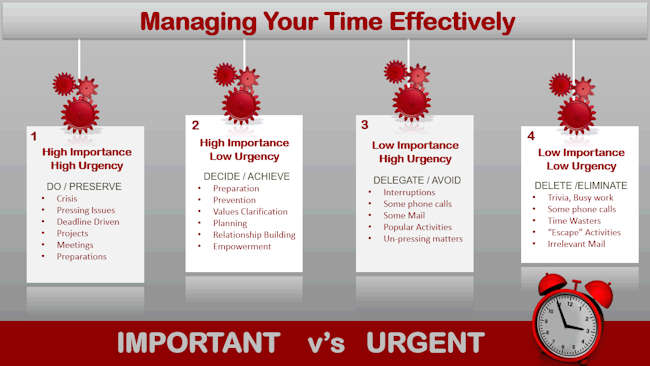
To become more productive, you need to eliminate time wasting activities!
copyright: 4p business development
Are you the business owner that is continuously in crisis mode? Do you spend much of you time firefighting? Are you juggling all the balls in the air and find it difficult to delegate? Do you check your email so often that it’s preventing you from getting any actual work done?
Then you’re confusing the urgent with the important. Continue in this mode, and you will ultimately drain all of your energy and leave you with little to show for it at the end.
Nearly every business person experiences distractions and interruptions that get in the way of your work. You don’t have to suffer from the loss of focus anymore. Now is the time to use a model to prioritise your to-do list.
“What is important is seldom urgent, and what is urgent is seldom important!”
As a business owner, it is paramount that you understand the difference between what is important to you and your business and what is urgent.
Take that to-do list and use the model below to evaluate what exactly you should be doing now, and perhaps more importantly, what you should be delegating and what you should be avoiding entirely.
-
DO/PRESERVE
Urgent and important (tasks you will do immediately)
-
Crisis
-
Pressing issues
-
Deadline driven
-
Projects
-
Meetings
-
Preparations
-
-
DECIDE/ACHIEVE
Important, but not urgent (tasks you will schedule for later)
-
Preparation
-
Prevention
-
Values clarification
-
Planning
-
Relationship building
-
Empowerment
-
-
DELEGATE/AVOID
Urgent, but not important (tasks you will delegate to others)
-
Interruptions
-
Some phone calls
-
Some mail
-
Popular activities
-
Un-pressing matters
-
-
DELETE/ELIMINATE
Neither urgent nor important (tasks that you will eliminate)
-
Trivia, busy work
-
Some phone calls
-
Time wasters
-
‘Escape’ Activities
-
Irrelevant mail
-
As a business owner, you should only be working on the important issues and matters within your business. How many of you are in the 4th list dealing with trivial and irrelevant matters?
“The next issue you may encounter is how to make important tasks urgent!”
The easiest way to make sure an important task urgent is to give it a deadline. So the first thing that you have to do if you want to make sure important tasks get done is to set deadlines.
So very often, a really important task is more like a project inasmuch as it’s huge and needs a tremendous amount of work. In order for you to set deadlines, you first have to break it down into smaller tasks and set deadlines for each of those.
When I listen to business owners telling me that they can do the job better themselves so they will not delegate, I realise immediately that they need my help!
In order to work on the business and to make it a success, you need to take a step back. It is paramount that all the tasks in the Low/Important boxes are delegated. Next, you need someone to delegate all the less important task to, and remember, you must keep those people accountable.
When it comes to holding other members of your team accountable to deadlines, it’s important to make people realise how important these deadlines are to you. You can’t tolerate missed deadlines. And that means actually checking in and having uncomfortable conversations when deadlines are missed.
If you don’t do this, then people will understandably assume that deadlines aren’t that important to you, and they’ll start getting pushed back or missed more and more often.
“Will this help you to achieve your goals and aspirations?”
One final note: it can be hard to eliminate time wasting activities if you aren’t sure what you are working toward. In my experience, there are two questions that can help clarify the entire process behind the Eisenhower Method:
-
What am I working toward?
-
What are the core values that drive my life?
Take control, be more productive and eliminate time wasting activities by using the Eisenhower Box and/or the Important vs Urgent model. these simple decision matrices will help you take action, organise tasks, and get more done.
The great thing about them is that they can be used for broad productivity plans such as, “How should I spend my time each week?” and for smaller, daily plans, “What should I do today?”
“Would you like to know more?”
If you’d like some help eliminating time wasting activities which, in turn, makes you more productive, give me a call on 01280 700405 or click here to send me an email enquiry and I’ll ask you some bloody difficult questions about what’s holding you back.
Until next time …
KATH BONNER-DUNHAM
|
PS: |
If you’re looking for a partner to help grow your business, visit www.4pbusinessdevelopment.co.uk to discover how 4P Business Development can help you! |
Do you even know?
It’s a question every business owner must ask themselves regularly: how profitable is my business? Do you even know how much profit you created this month?
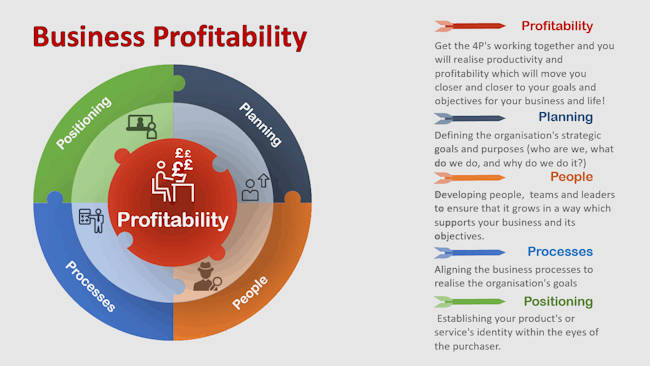
Profitability is a measurement of efficiency, and ultimately its success or failure!
copyright: 4p business development
Get the 4P’s of planning, people, processes and positioning working together and you will realise productivity and create profitability which will move you closer to your goals and objectives for both your business and your life!
“You must understand the numbers and how the business makes money!”
Many owners and managers have never been taught this concept and the importance of key financial terms and business processes. Surveys reveal a gap between financial ‘confidence’ and ‘competence’, which can be critical to an organisation’s performance.
So what is profit? It is simply the state (or condition) of yielding a financial gain in an enterprising activity after all of the expenses are paid.
“Remember the saying: turnover’s vanity, profit’s sanity, and cash is always king!”
Typically, when I first interact with a new client, their focus is on turnover. They frequently tell me “I must get more clients to make more money”. Very often this is far from the truth and, surprisingly enough, it may well be that they need to actually get rid of some of their clients!
|
|
But why would you want to do that? Well, once I begin looking at profitability and the 4P’s it may become obvious:
-
They do not have the right people doing the right jobs
-
Incorrect processes and systems in place to ensure the business mechanics run smoothly
-
Business marketing not positioned properly so not focusing on their target market
-
They are not working to a strategic plan
-
Most importantly, their existing client base is not making any money
Do you know if each and every one of your individual clients and/or products are profitable? I would begin by grading all of your clients from:
-
High Profit: Low Maintenance
-
Medium Profit: Low Maintenance
-
Low Profit: Medium Maintenance
-
Low Profit: High Maintenance
And then ‘sack’ all of the Grade D clients who are low profit and high maintenance. The best and easiest way to do that is to increase your prices! You will be extremely surprised how much productivity and profitability can literally grow overnight!
“It is also important for you to use the most appropriate accounting system!”
Not the one that is your accountants favourite, but the one that really fits your personal need, one that you can easily access on a daily basis, one that you understand and one that assists you in your forecasting and financial planning.
Some of the comments I hear time and time again after working on the profitability of an organisation are, ”I can now sleep at night”, ”This is so easy! I now understand where all my money is coming from and going to”, ”It is now fun to forecast and plan for the future” and ”I wish I had known you years ago and taken control much sooner”.
In a competitive marketplace, it is important that you learn how to achieve a satisfactory level of profitability. Increasing profitability involves determining which areas of your financial strategy are working for you and which ones need improvement.
Understand some of the important decisions you are likely to face, which will enable you to plan for this important transition and enjoy a future that you have worked hard to achieve:
-
Establish a robust financial plan
-
Make good financial decisions including pension allowances and rules
-
Achieve your financial goals
-
Effective tax planning
-
Overview of succession, will and estate planning
-
Accessing financial advice and/or doing it yourself
Finance used to be just about numbers in rows and columns. Now it is easy to realise the potential, to use new analysis tools, and to actually see the trends, the story, and the power that data brings.
“Remember, making money is about you, not your business. The foundation of business success is your confidence in yourself!”
That’s where I can help. I can coach and mentor you to make profitability-driven decisions. I’ll introduce you to my trusted partners who are all experts in their field and take a modern approach to business intelligence.
|
|
If you’d like me to work with you and your team to ensure you are following my 4P programme which will move you toward profitability then do call me on 01280 700405 or click here to send me an email enquiry and let’s start a conversation.
Until next time …
KATH BONNER-DUNHAM
|
PS: |
Profitability is closely related to profit, but it is the metric used to determine the scope of a company’s profit in relation to the size of the business. Profitability is a measurement of efficiency, and ultimately its success or failure. It is expressed as a relative, not an absolute, amount. |
|
PPS: |
Profitability can further be defined as the ability of a business to produce a return on an investment based on its resources in comparison with an alternative investment. Although a company can realise a profit, this does not necessarily mean that the company is profitable. |
You don’t need a long, tedious business plan …
Have you ever written down and communicated your goals? When you have written goals and objectives in place, you will find that you are able to spend time managing your business …

Write down and communicate your goals and objectives, and plan for continued success!
copyright: 4p business development
Once written down and communicated, you will then be in the best position to make operational decisions based on what you’ve already outlined in your goals and objectives list.
“Do you really need that long, tedious business plan that you have been told you must have?”
Once completed, the likelihood is that you will never look at it again. It will be locked away in a draw and, to be honest, it is of absolutely no use to you whatsoever. It’s out of date as soon as it’s completed.
So what does work and why should you plan? “Unless commitment is made, there are only promises and hopes; but no plans.” A business plan is a tool to aid decision making, it should be a living document that works for you, that is continuously reviewed in light of the business environment and actual performance.
“This enables the business owners to oversee business performance and make informed decisions!”
The strategic planning process is a valuable and exciting exercise that can be a major contributor to team building and a means of developing ownership/commitment to the plan. Involve people because it should end up as ‘our plan’ not ‘their plan imposed on us’.
I work with a three step process beginning with a ‘goals wheel’ culminating with a ‘living’ plan that assists with commitment and continued accountability.
|
|
There are various exercises that I can introduce that would be helpful in the planning process:
-
Explore your vision for the future of the business. Take the time to reflect and think of what you aspire to for your life and business in the future. This is the time to be creative, thinking ‘without boundaries’ and exploring exciting opportunities three to five years in advance.
-
Consider your business and the goals you have for the growth/exit for the business. List anything and everything you could possibly want; go on, be brave and dream big!
-
Strategically plan all aspects of your Goals Wheel, listing all the attributes and targets you believe the business must have in order for you to reach your personal and business goals and aspirations. Ensure all targets and goals are S.M.A.R.T.
Working with a Business Mentor on this important aspect of planning is key to the success and implementation of the plan resulting in:
-
Clarity of the goals and targets you have set.
-
Confidence that you have the knowledge skills and competencies to achieve these goals.
-
Motivation to get out of bed and achieve.
-
Accountability ensuring commitment to carry out your plans.
You will have done a lot of work to get this far, understanding your vision and goals with a strategic plan is a great start.
|
|
This is when the hard work really begins. You will work tirelessly on your plan and realise that along the way adjustments need to be made and occasionally ideas and goals totally change. I always encourage continuous review and 90 day planning meetings to plan, implement, reflect, review and improve for continued success.
“Why would planning help a business that has a few years of history more than one that is just starting up?”
Some fascinating studies have demonstrated that proper planning can help companies grow at least 30% faster. One study, published in 2010, aggregated research on the business growth of 11,046 companies and found that planning improved business performance.
Interestingly, this same study found that planning benefited existing companies even more than it helped start-ups. But, this study still doesn’t answer the question it raises: “why would planning help a business that has a few years of history more than one that is just starting up?”
The answer (most likely) lies in the fact that existing businesses know a bit more about their customers and what their needs are than a new start-up does. For an existing business, planning involves fewer guesses or assumptions that need to be proven, so the strategies they develop are based on more information.
Another study found that companies that properly plan grow 30% faster than those that don’t plan. This study found that plenty of businesses can find success without planning, but that businesses with a plan grew faster and were more successful than those that didn’t plan.
To reinforce the connection between planning and fast growth, yet another study (last one for today!) found that fast-growing companies that had over 92% growth in sales from one year to the next usually have business plans.
“In fact, 71% of fast-growing companies have plans!”
They create budgets, set sales goals, and document their marketing and sales strategies so my call to action this week is for you to take some time to work on your business to set goals and build a plan for your future.
More importantly, re-visit your plan as you grow and revise it as you learn more about your business and your customers.
And if you’d like a coach to keep you on track, why not call me on 01280 700405 or click here to send me an email enquiry and let’s have a conversation about your goals and objectives to see how I can help you.
Until next time …
KATH BONNER-DUNHAM
PS: The study information in my blog post this week was provided by the Journal of Management Studies.
Let’s get those cogs working together …
One of the first things I teach people who work with me is that comprehensive business goals and objectives are key to the success of any business …
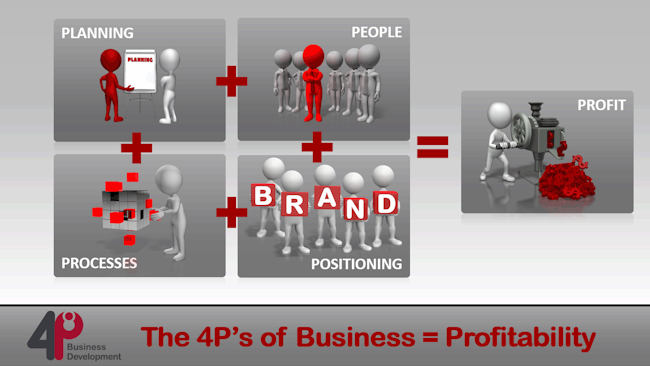
The 4P’s Of Business need goals and objectives to make them work!
copyright: 4p business development
And that’s never more important than when that business is owned by you. So let me ask a couple of easy questions.
Firstly, when did you last actually take the time out of the day job to focus on your end goals for both your business and your personal life? And, just as importantly, are the two concurrent or are they miles apart in respect of timescales and financial requirements?
“That’s the first stage of how I can help you!”
I ask the bloody difficult questions, and then support, encourage and guide you to set those goals, to achieve your aspirations and realise your true potential by holding you accountable.
Once you’ve set your goals and objectives, there are 4P’s that must be developed to get you there. These are planning, people, processes and position.
Get these cogs working together and you will create profitability:
-
Planning
Have you written down and communicated your goals? When you have written goals and objectives in place, you will find that you are able to spend time managing your business.
You will then be in the position to make operational decisions based on what you’ve already outlined in your goals and objectives list.
-
People Management
Do you have the right people in your business? Too many managers employ people to match the job role that is currently in place.
However, great managers seek the employee with the style and type that suits their business culture, whose skills and talent can redefine how that job is carried out, adding productivity and profitability to the bottom line.
-
Process and Systems
How efficient is your business? How many tasks could be streamlined or carried out in a more efficient manner? You’ll be surprised at what I discover!
I will scrutinise your business processes to identify how and where they can be streamlined, whether process order can be improved, if existing tools can be better utilised, and where investment in new systems or equipment can be justified.
-
Positioning
When did your last review your marketing activity, PR, customer experience, client retention and position in your market?
Marketing can be defined as the intermediary function between product development and sales. It is the marketing professional’s job to create, manage and enhance brands.
-
Profitability
Get the 4P’s working together and you will realise productivity and profitability which will move you closer and closer to your goals and objectives for your business and life!
I read a really interesting article in the Guardian recently and thought I would quote a little of it here:
“Business efficiency is crucial to business success, but what is often underestimated is the importance of business owner efficiency, and having a founder who can demonstrate consistency and speed in things like planning, time management and decision-making from day one.
However, when you are caught up in the often chaotic early days of setting up and growing a new business, thinking and acting efficiently may be easier said than done. This is why many business owners engage the services of a business coach.”
My thoughts exactly! And if that resonates with you too, and you’d like to explore working together to set your goals and objectives, optimise your planning, people, processes and position and achieve productivity and profitability then I’d love to talk to you.
“Am I the right person to be your business coach?”
You can learn if working together would be a great idea by calling me on 01280 700405 or you can click here to send me an email enquiry, let’s start a conversation and we can find out.
Until next time …
KATH BONNER-DUNHAM
PS: If you’re looking for a partner to help grow your business, visit www.4pbusinessdevelopment.co.uk to discover how 4P Business Development can help you!
What our clients say




Copyright © 2017. All rights reserved. 4P Business Development Ltd.
Registered in England No. 7378143
4P Business Development Ltd,11 Prices Way, Brackley NN13 6NR.
VAT No. 1004444867
Statutory Information | Terms & Conditions | Social Media Policy
Website by Bubble Creative Solutions Ltd